In brief
- Adani Ports and Special Economic Zone Limited confirms an all cash agreement to acquire 100 percent of Evos B.V. for an enterprise value of €2.56 billion, with equity consideration of €1.18 billion, signalling Adani’s entry into continental Europe’s energy infrastructure.
- Evos is Europe’s second largest independent liquid storage provider, carved out of Vopak’s terminal portfolio in 2019, and operates eight deep water port based terminals across Amsterdam-Rotterdam-Terneuzen, Hamburg, Algeciras, Spain and Malta.
- The Evos network comprises 452 storage tanks with a capacity of 63 lakh cubic metres and 63 vessel and barge berths, handling 3.7 crore metric tonnes of liquid throughput in calendar year 2025.
- The acquisition expands Adani’s international portfolio into critical energy and chemical infrastructure across Europe, positioning the group to build transcontinental green energy corridors beyond its existing overseas cargo operations.
On 5 November 2026, Adani Ports and Special Economic Zone Limited (APSEZ) confirmed its most ambitious international transaction to date: an all-cash agreement to acquire 100% of Netherlands-headquartered liquid storage operator Evos B.V. from Igneo Infrastructure Partners. The deal values Evos at an enterprise value of €2.56 billion ($2.88 billion / ₹27,142 crore), with an equity consideration of €1.18 billion (₹12,511 crore).
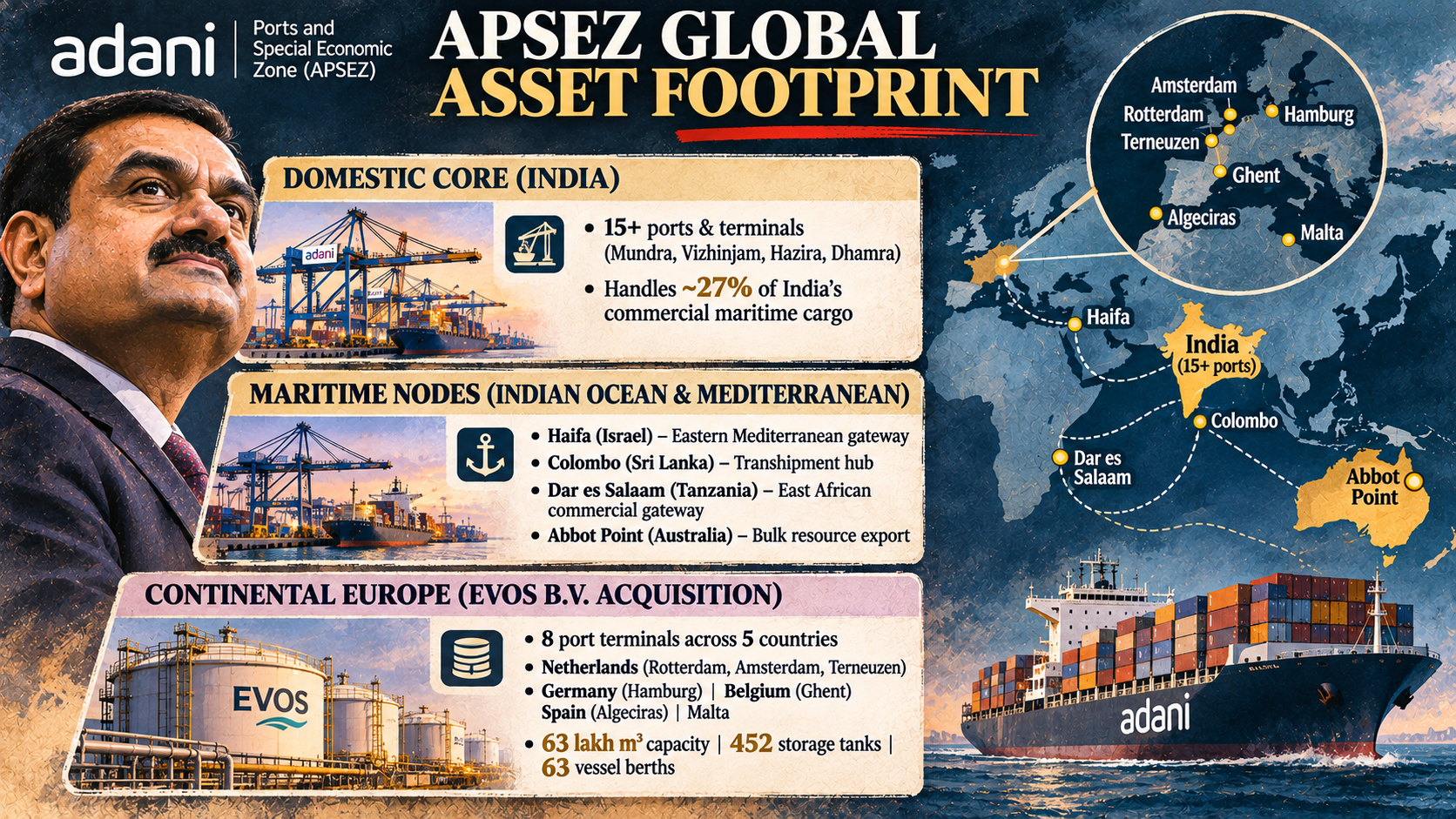
The transaction marks the formal entry of billionaire Gautam Adani’s industrial conglomerate into continental Europe. Until now, APSEZ’s international portfolio had expanded across strategic maritime choke points in the Global South—including Colombo’s West Container Terminal in Sri Lanka, the Port of Haifa in Israel, Dar es Salaam in Tanzania, and Abbot Point in Australia.
By purchasing Evos, APSEZ is not simply acquiring overseas cargo volumes; it is taking ownership of critical energy and chemical infrastructure at the heart of the European Union.
The Asset: What Adani Bought in Evos B.V.
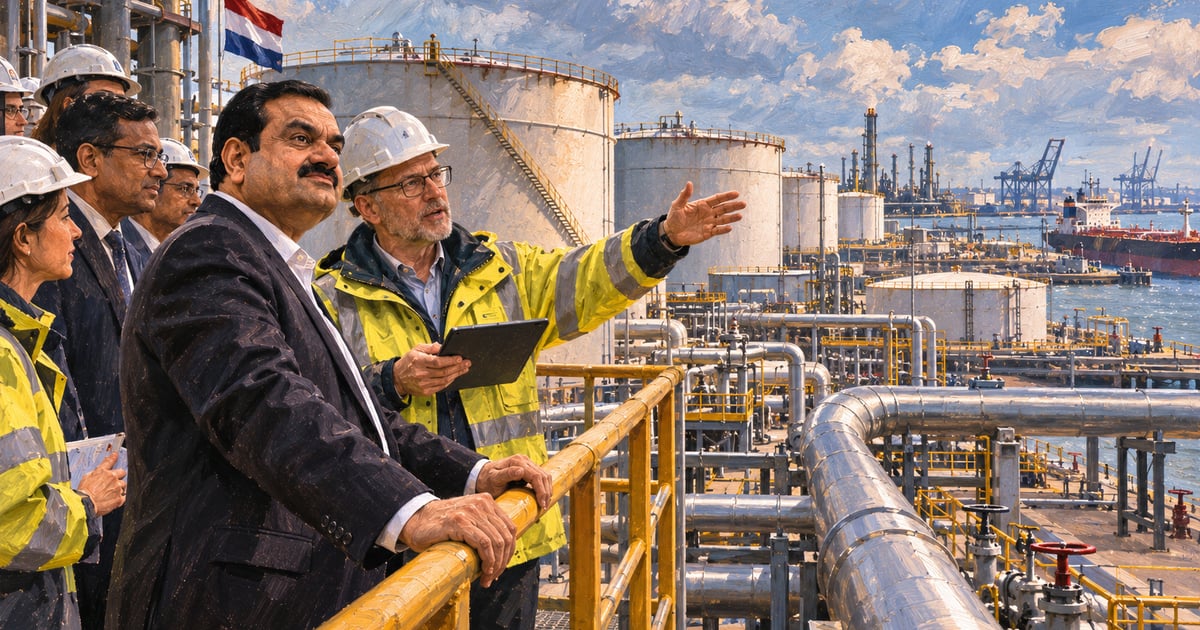
Evos is Europe’s second-largest independent liquid storage provider, carved out of Vopak’s terminal portfolio in 2019 by Igneo Infrastructure Partners (an asset management arm of First Sentier Investors). Headquartered in Amsterdam, the company operates eight deep-water, port-based terminals situated in Europe’s primary industrial clusters:
The ARA Hub (Amsterdam-Rotterdam-Terneuzen, Netherlands & Ghent, Belgium): Positioned within the world’s most active petroleum and chemical trading complex.
Hamburg, Germany: Serving northern Europe’s industrial heartland and inland waterway connections.
Algeciras, Spain & Malta: Strategic bunkering and transhipment hubs controlling Western Mediterranean and trans-Suez maritime traffic.
Across these locations, Evos operates 452 storage tanks with a cumulative capacity of 63 lakh cubic metres (6.3 million cubic metres) and 63 dedicated vessel and barge berths. In calendar year 2025, the business handled 3.7 crore metric tonnes (37 million metric tonnes) of liquid throughput.
Crucially, Evos is not merely an isolated collection of storage tanks; it is deeply integrated into Europe's downstream distribution backbone. Its terminals connect directly to national rail networks, inland waterways, the Central Europe Pipeline System, and dedicated jet fuel supply pipelines feeding Amsterdam Airport Schiphol.
The Financials: Valuation, Yields, and Leverage
The transaction is valued at an enterprise multiple of 11.7x CY25 EV/EBITDA. For CY25, Evos delivered:
Revenue: €392 million (approximately ₹3,530 crore)
EBITDA: €219 million (approximately ₹1,970 crore)
EBITDA Margin: 56%
For APSEZ, the financial appeal lies in cash-flow stability and margin expansion. While container shipping and dry-bulk handling are exposed to macroeconomic demand cycles, liquid storage functions on multi-year, "take-or-pay" contracts. Evos reports an average commercial occupancy rate of 99%, with customer tariffs tied directly to national consumer price indices (CPI).
Evos’s 56% operating margin is immediately accretive to APSEZ’s existing international port operations, which logged an EBITDA margin of 44.8% in the first half of FY27.
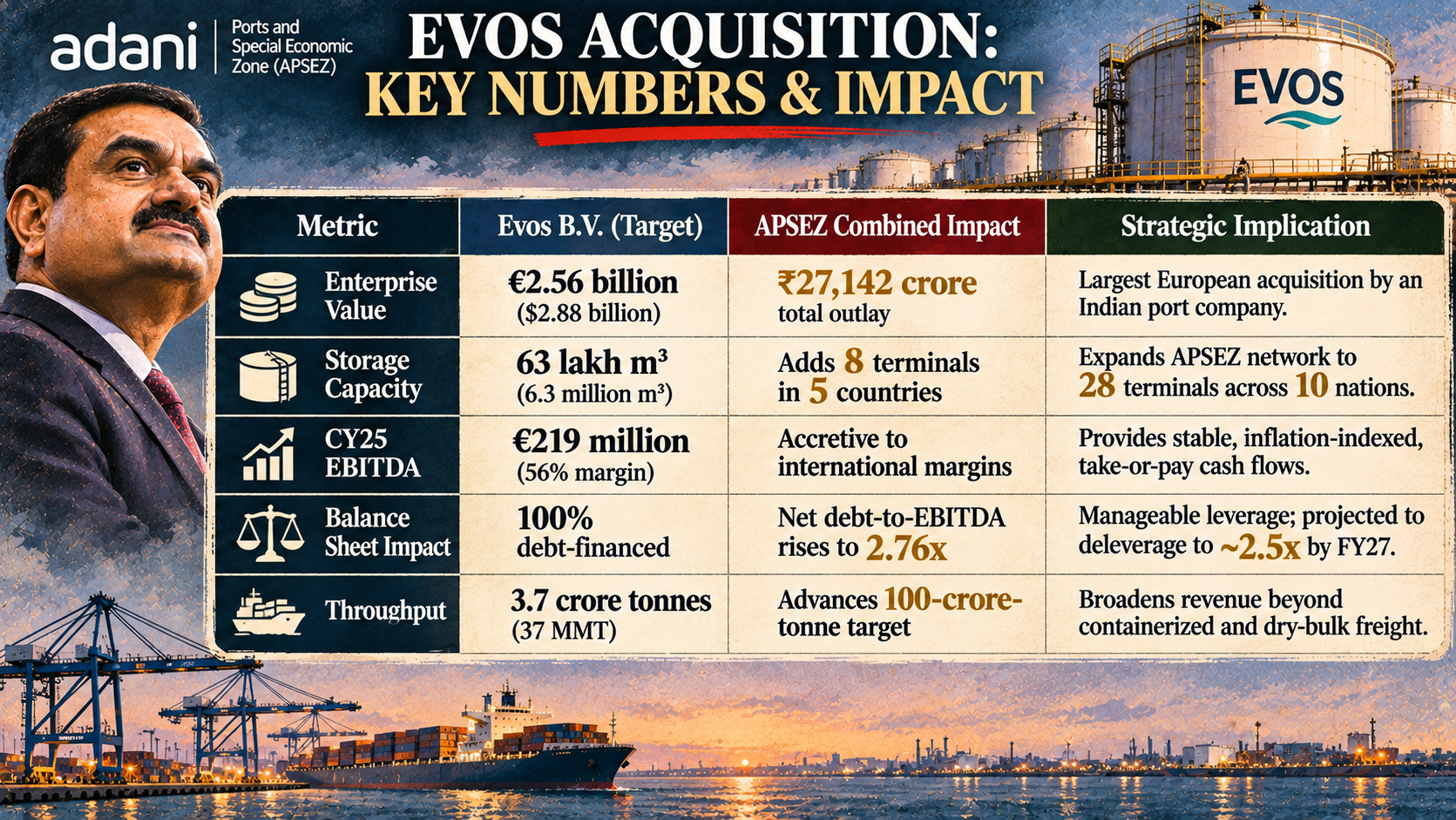
To finance the €1.18 billion equity check and refinance underlying debt, APSEZ is deploying cash reserves and newly arranged debt facilities. The acquisition increases APSEZ’s consolidated net debt-to-EBITDA ratio from approximately 2.3x to 2.76x on a pro-forma basis. Management has outlined a deleveraging trajectory aimed at bringing the ratio back toward 2.5x by FY27, backed by Evos’s predictable free-cash generation.
The Big Plan: Deconstructing Adani’s Three-Tier Strategy
To understand why an Indian infrastructure conglomerate is spending billions on European tank farms, one must look beyond quarterly logistics earnings. The Evos acquisition serves three distinct strategic objectives:
1. Anchoring the Green Energy Export Corridor
The cornerstone of Gautam Adani’s long-term capital allocation is the green energy transition. In Khavda, Gujarat, the group is constructing a massive 30-gigawatt hybrid solar and wind installation. Through Adani New Industries, the conglomerate is committing tens of billions of dollars to convert this cheap renewable electricity into green hydrogen and green ammonia.
However, green hydrogen cannot be transported economically without specialized reception infrastructure. Europe, under its strict RePowerEU mandates, is targeting 1 crore tonnes (10 million tonnes) of domestic renewable hydrogen production and an additional 1 crore tonnes of imports by 2030.
By acquiring Evos, Adani solves the off-taker bottleneck. The group now controls:
The Origination End: Low-cost green electron and molecule manufacturing in Western India.
The Maritime Transit: Port handling through Mundra and deep-water transhipment at Vizhinjam.
The Destination Gateways: Liquid reception, regasification, and chemical storage berths in Rotterdam, Amsterdam, Ghent, and Hamburg.
Evos’s existing infrastructure is already being engineered to handle sustainable aviation fuel (SAF), bio-ethanol, e-methanol, and clean chemical feedstocks. Adani can now offer European industrial customers a closed-loop supply contract: produced in Gujarat, shipped via dedicated tankers, stored in Adani-owned European tanks, and fed directly into the Rhine-Ruhr industrial pipeline grid.
2. The IMEC Commercial Backbone
The Evos transaction aligns directly with the geopolitical geography of the India–Middle East–Europe Economic Corridor (IMEC). Backed by New Delhi, Washington, and European capitals, IMEC aims to create an integrated multimodal rail, maritime, and pipeline route connecting Western India to continental Europe via the Arabian Peninsula and the Mediterranean.'
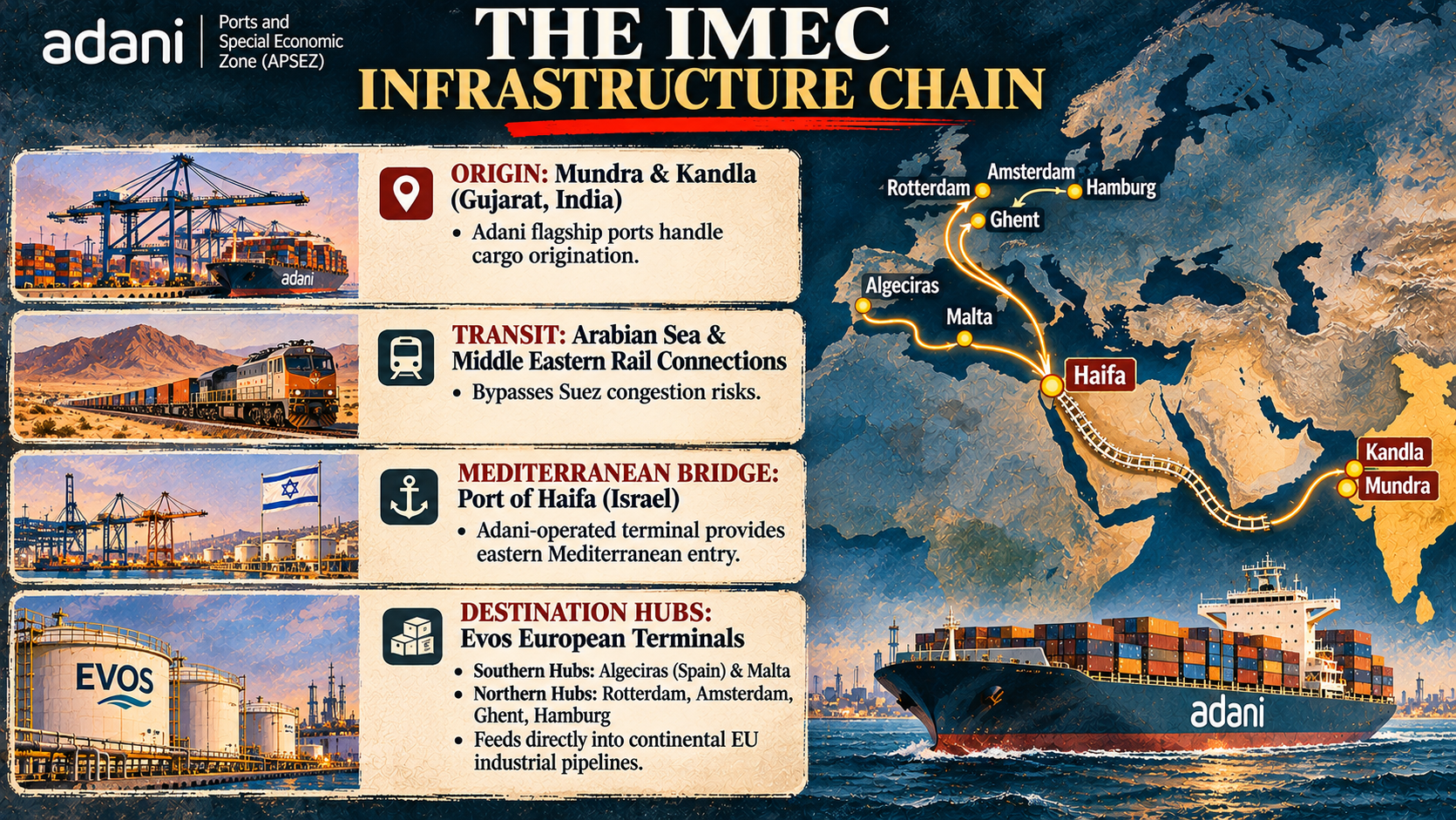
By placing Haifa on the Mediterranean side and Evos across Northern and Southern Europe, APSEZ has assembled terminal nodes across the entire IMEC perimeter.
3. Pre-empting European Storage Consolidation
Adani’s European ambitions became visible in late October 2026, when reports emerged that the group was assessing a buyout of rival Dutch storage operator VTTI (co-owned by Vitol, IFM Investors, and ADNOC). While VTTI negotiations stalled, the pivot to Evos confirms that European liquid storage was a deliberate target rather than an opportunistic one-off.
As European refiners close older facilities and shift toward imported transition fuels, independent storage assets with pipeline connections have become scarce, highly defensive infrastructure. Securing 63 lakh cubic metres of capacity locks out global competitors and gives Adani immediate pricing leverage in European fuel blending and trading markets.
Regulatory Hurdles and Geopolitical Headwinds
While APSEZ’s board has approved the buyout, the deal must navigate a complex European regulatory gantlet before closing in 2027:
Foreign Direct Investment (FDI) Scrutiny: Over the past three years, European nations have tightened screening mechanisms for non-EU buyers acquiring critical infrastructure. Evos’s pipeline connections to military supply routes—specifically the NATO Central Europe Pipeline System—and major commercial airports mean national security regulators in the Netherlands, Germany, and Belgium will examine the transaction thoroughly.
Works Council Approvals: In accordance with Dutch and European labour legislation, the transaction is subject to formal consultation with Evos’s works councils and trade union representatives.
Corporate Scrutiny: European regulators may review governance structures and capital origin, given past international scrutiny of emerging-market infrastructure conglomerates.
APSEZ, however, has structured the buyout through clean corporate balance-sheet debt with established international banking syndicates, emphasizing that Evos will retain its local Dutch executive management and operational staff.
The Road Ahead
"Evos marks an important milestone in APSEZ’s trajectory towards handling 100 crore metric tonnes (1 billion tonnes) of cargo and building a truly global, integrated transport platform," noted Karan Adani, Managing Director of APSEZ.
The acquisition signals a decisive strategic evolution for the Adani Group. No longer content with dominating domestic Indian logistics, the company is using its formidable balance sheet to purchase critical chokepoints along global trade corridors. If the transaction completes as planned, Gautam Adani will have secured what few non-Western industrialists have ever achieved: permanent, proprietary control over the physical valves that power European commerce.