In virtually every residential compound, public park, and village square across China, one encounters the same unmistakable sight: rows of bright yellow, red, and blue steel exercise fixtures—waist twisters, air walkers, pull-up bars, and outdoor ping-pong tables. Stencilled onto each piece of steel is a small red and yellow emblem: China Sports Lottery (Zhongguo Tiyu Caipiao).
To neighbourhood retirees, these installations are known simply as "National Fitness Paths". To the state, however, they represent only the visible grassroots tier of a colossal financial apparatus.
Behind China’s consistent top-tier finishes at the Summer Olympics, Winter Olympics, and Asian Games lies a massive, off-budget cash reservoir. Far from relying purely on general taxation, China’s elite athletic machinery—the legendary Juguo Tizhi (举国体制, or "whole-nation system")—is bankrolled by state-sanctioned sports gambling.
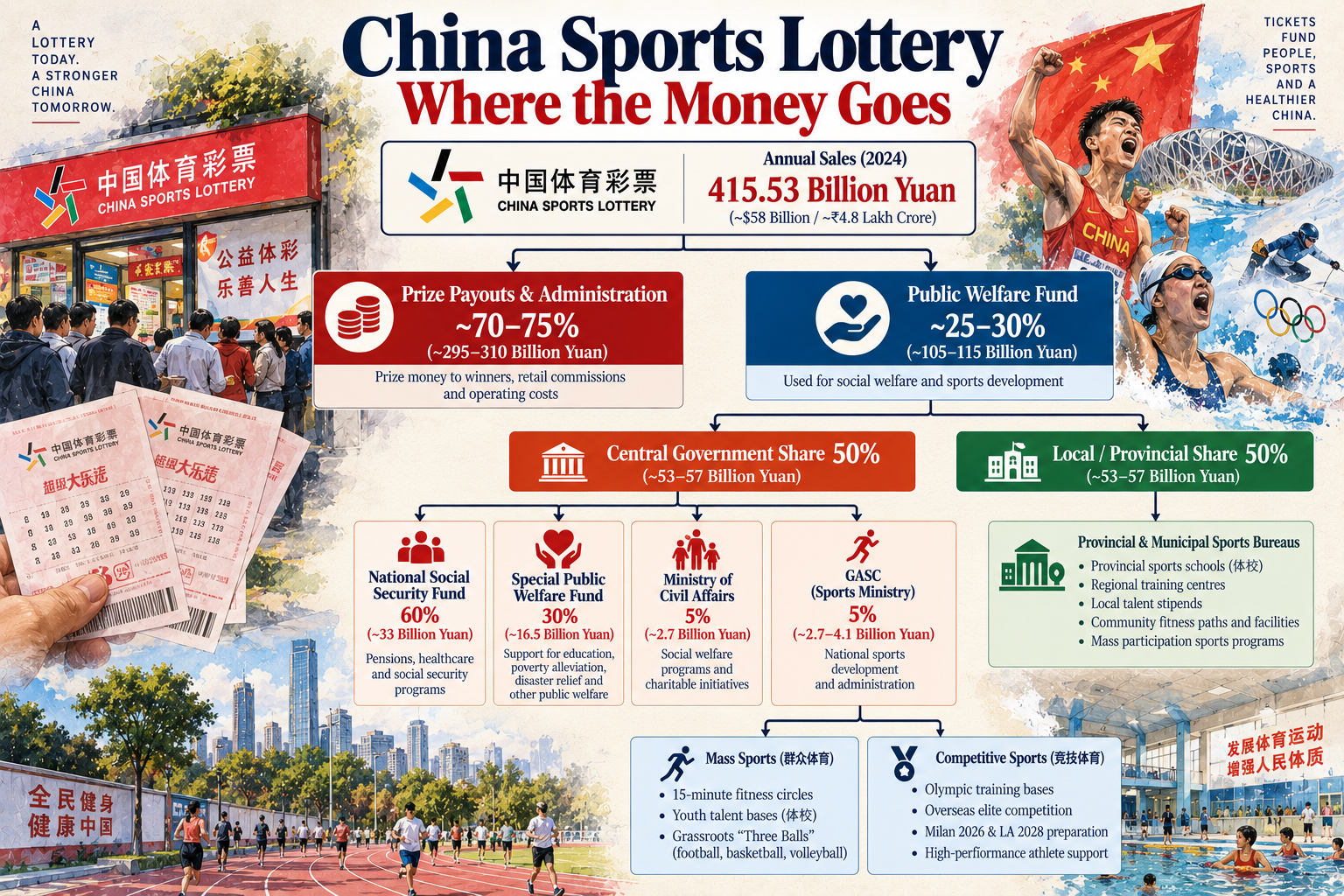
In 2024, annual lottery sales in China reached an all-time high of 623.49 billion yuan ($86.96 billion / ₹7.25 lakh crore), according to data released by the Ministry of Finance. Of that total, the China Sports Lottery generated 415.53 billion yuan ($57.9 billion / ₹4.83 lakh crore), capturing 66.6% of the national market.
That turnover yielded tens of billions of yuan in statutory "Lottery Public Welfare Funds", funnelling an estimated $8 billion to $14 billion annually across central and provincial sporting bodies to build fitness infrastructure, maintain high-tech national training bases, and scout youth talent.
Rescuing the Whole-Nation System
China’s athletic triumphs were not always self-funding. During the planned economy era of the 1950s through the 1980s, Soviet-style athletic schools (tixiao, 体校) were funded directly from the state treasury. Elite athletes were civil servants in all but name, sequestered in full-time facilities.
However, as Deng Xiaoping’s market reforms gathered pace in the 1980s and 1990s, the central government dismantled direct fiscal guarantees for non-productive sectors. Local sports academies struggled to pay coaches, maintain decaying gyms, or provide adequate nutrition. When China hosted the 1990 Asian Games in Beijing—its first major international sporting showcase—the municipal and central governments faced severe capital shortfalls and were forced to issue temporary donation lottery tickets.
Recognising that elite sports could no longer rely solely on general tax revenues, the State Council formally approved the creation of the China Sports Lottery in 1994, granting operational authority to the State Sports Commission (now the General Administration of Sport of China, or GASC) alongside the Ministry of Finance.
In September 1998, Beijing codified this arrangement by issuing the Interim Measures for the Management of the Sports Lottery Public Welfare Fund, creating a statutory mechanism that turned legalised betting into a permanent institutional lifeline, as documented in public policy research published in Frontiers in Sports and Active Living.
The timing was decisive. As academic studies in the International Journal of the History of Sport note, by the late 2000s, commercial revenue and the sports lottery accounted for roughly 40% of the entire elite sports budget, relieving direct fiscal pressure while funding the "Olympic Strategy" that catapulted China to 51 gold medals at the Beijing 2008 Games.
How the Money Moves: The 50/50 Split
Under the State Council's Regulations on the Administration of Lotteries, ticket proceeds follow a strict distribution formula:
Prize Pool: 50% to 65% is returned to ticket buyers as winnings, depending on whether the game is a scratch-off, numerical draw, or sports wager.
Issuance and Operations: Roughly 13% to 15% covers retail vendor commissions, administrative expenses, and software management.
Public Welfare Fund: The remaining 25% to 35% is extracted as public welfare capital.
Between 2012 and 2022 alone, Sports Lottery ticket sales totalled 2,198.6 billion CNY ($306 billion / ₹25.5 lakh crore), generating 553 billion CNY ($77 billion / ₹6.4 lakh crore) for sports public welfare funds. That equates to an average annual cash pile of over 55 billion yuan ($7.7 billion / ₹64,000 crore).
The distribution of this capital follows a distinct two-tier model:
50% Stays with Local Governments: Half of all funds raised remain in the provinces, autonomous regions, and municipalities where tickets were purchased. Provincial sports bureaus deploy this cash directly to finance provincial athletic squads, upgrade local sports boarding schools, and pay stipends to teenage prospects.
50% Goes to the Central Treasury: The central government pool is split by statutory decree: 60% is directed to the National Social Security Fund, 30% to special central public welfare projects, 5% to the Ministry of Civil Affairs, and 5% directly to GASC.
While 5% of the central pool may appear modest, the sheer scale of modern lottery turnover translates this into massive annual liquidity.
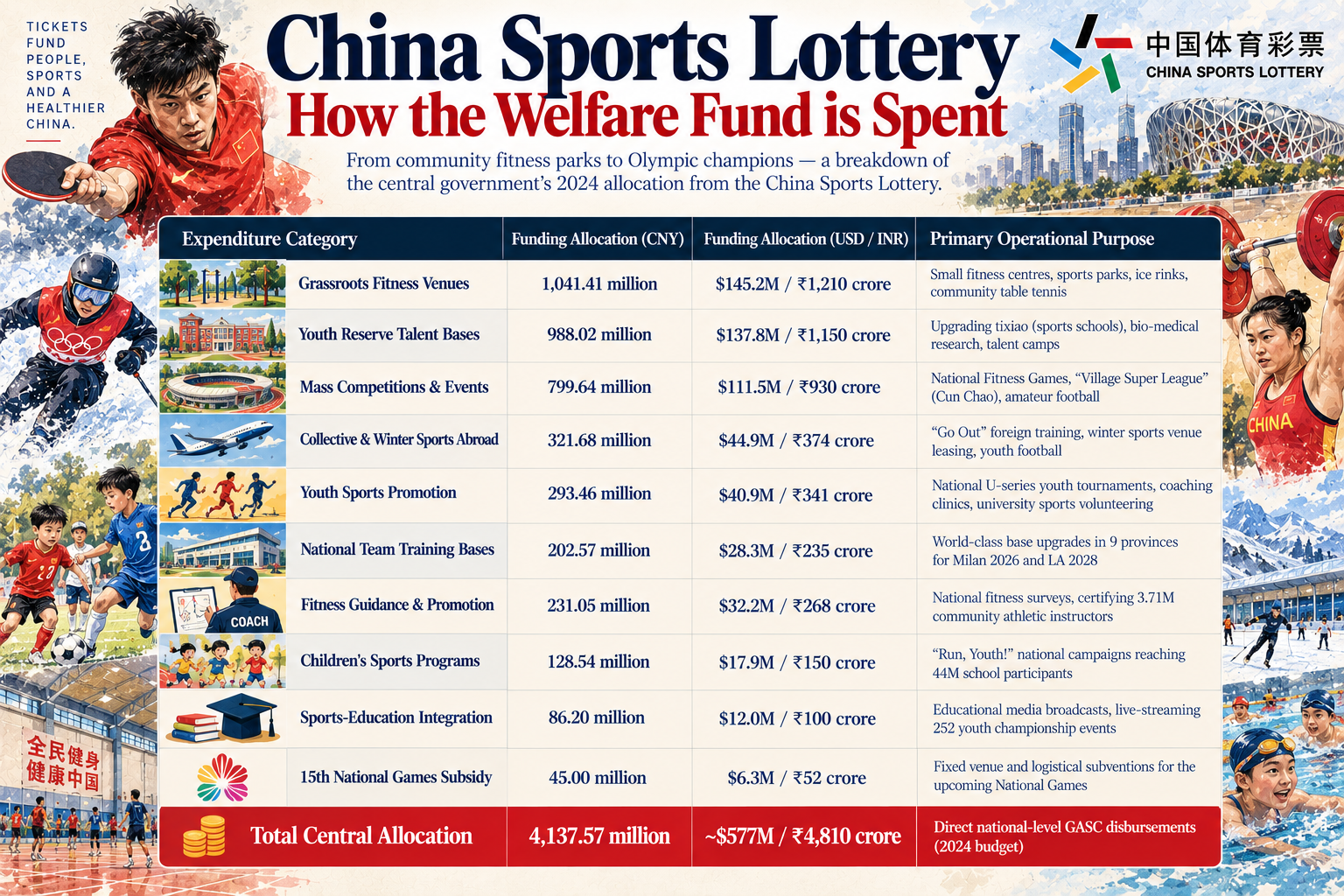
According to GASC’s audited annual expenditure bulletin published via Xinhua, the central sports ministry used 4.138 billion yuan ($577 million / ₹4,810 crore) of lottery welfare funds in 2024 alone. Combined with provincial sports bureau expenditures, total sports lottery proceeds channelled directly into sports development across China routinely exceed $8 billion annually.
The Two Pillars: Elite Gold vs Mass Fitness
Statutory policy mandates that sports lottery funds serve two intertwined objectives: competitive elite sports (Jingji Tiyu) and public mass sports (Qunzhong Tiyu).
Building Champions: High-Tech Scouting and Isolated Bases
In the elite sports category, sports lottery capital has modernised China’s athletic pipeline from crude Soviet physical conditioning to cutting-edge sports science.
Nearly 1 billion yuan ($138 million / ₹1,150 crore) of the central 2024 lottery allocation was targeted directly at "National High-Level Sports Reserve Talent Bases". These institutions represent the top tier of China’s 2,000+ specialized sports schools. Lottery funds are used to install advanced diagnostic sensors, high-speed motion capture cameras, hypoxic chambers, and sports psychology labs, allowing coaches to identify physiological traits in children as young as six or seven.
Lottery funds also finance China’s network of specialized, self-contained national training sanctuaries outside major urban hubs. As highlighted in sports policy documentation from Maynooth University and Taylor & Francis, bases such as the Duoba High-Altitude Training Base in Qinghai (track and field), the Qiandaohu Aquatic Base in Zhejiang (rowing and canoeing), and Sanya Aquatic Camp in Hainan (sailing) receive ongoing capital subsidies from lottery funds.
National squads regularly spend eight to ten months a year in these isolated compounds, shielded from domestic distractions with all accommodation, catering, altitude acclimatisation, and medical monitoring covered by the sports lottery.
Furthermore, under the "Go Out" (Zou Chuqu) strategy, lottery funds subsidise national squads in non-traditional sports—including women’s rugby, hockey, water polo, and winter sports—to train and compete year-round in Europe and North America, compensating for the lack of domestic competitive leagues.
Grassroots Reality: The 600,000-Village Gym
While elite gold medals dominate state propaganda, the mass sports allocation addresses a domestic political priority: the "Healthy China 2030" national strategy.
According to a global study by The Aspen Institute's Project Play, the sports lottery has funded the installation of basic fitness infrastructure across more than 600,000 administrative villages in China. This includes outdoor fitness paths, multipurpose concrete basketball courts, and outdoor table tennis arenas designed to build "15-minute fitness circles" in both metropolitan residential blocks and remote rural counties.
This mass funding serves two systemic functions:
Public Health and Legitimacy: It counters public resentment against the state spending billions on elite medals while ordinary citizens face soaring healthcare costs. Under current five-year plans, China aims to ensure 38.5% of its population regularly participates in physical exercise.
Grassroots Feeder Funnel: By subsidising certified "Social Sports Instructors"—a corps that reached 3.71 million certified instructors by the end of 2024, or 2.63 per 1,000 residents, according to GASC's audited report—local sports authorities maintain a presence in communities to spot exceptional adolescent talent and route them into the competitive sports pyramid.
The Socioeconomic Paradox: Why Lottery Revenue is Booming
The explosive growth of China’s Sports Lottery in recent years highlights a paradox in China’s domestic economy.
Throughout 2023 and 2024, as the Chinese economy encountered real estate downturns, youth unemployment pressures, and consumer hesitation, sports lottery ticket sales surged by double digits. In shopping malls across Tier-1 and Tier-2 cities, traditional drab betting shops have been replaced by sleek, modern lottery kiosks placed alongside milk tea outlets and designer boutiques.
Reporting by the South China Morning Post and VOA News reveals that young, educated urbanites are driving the boom, flocking to instant scratch cards (Guaguaka) and sports betting on European football and basketball as cheap, gamified entertainment.
Economists frequently describe lotteries as an implicit, regressive consumption tax: capital is collected disproportionately from working-class citizens and anxious youth hoping for sudden financial escape. In China, this dynamic has created an ironic fiscal cycle: the more uncertain economic prospects feel to young urbanites, the more tickets they buy—and the larger the off-budget cash pile available to the state to groom teenage Olympic divers, gymnasts, and weightlifters.
Governance, Audits, and Integrity Scandals
Operating outside the standard ministerial budget, the sports lottery's immense cash reserves have historically presented significant governance and corruption challenges.
In 2015, a nationwide investigation by the National Audit Office uncovered the misappropriation of 16.9 billion yuan ($2.7 billion / ₹17,000 crore) in lottery funds across 18 provinces. Municipal and provincial officials were found diverting public welfare revenues to build unauthorized government office buildings, pay illegal staff bonuses, and maintain off-the-books slush funds.
More recently, China’s sports bureaucracy has been engulfed in comprehensive anti-graft campaigns. In May 2024, Gou Zhongwen, the former director of the General Administration of Sport of China who oversaw Olympic preparations for Tokyo 2020 and Beijing 2022, was detained and placed under investigation by the Central Commission for Discipline Inspection (CCDI), culminating in severe criminal penalties for systemic bribery. His downfall followed sweeping purges across the Chinese Football Association and winter sports management centres, where commercial sponsorships, player selections, and public sports funding had become deeply compromised.
In response, the Ministry of Finance and the National People's Congress enacted a revised Sports Law in 2022, strengthening mandatory public disclosures and attempting to rebalance funding away from "pure medal worship" (Wei Jinpai Lun) toward educational integration and grassroots public health.
Conclusion
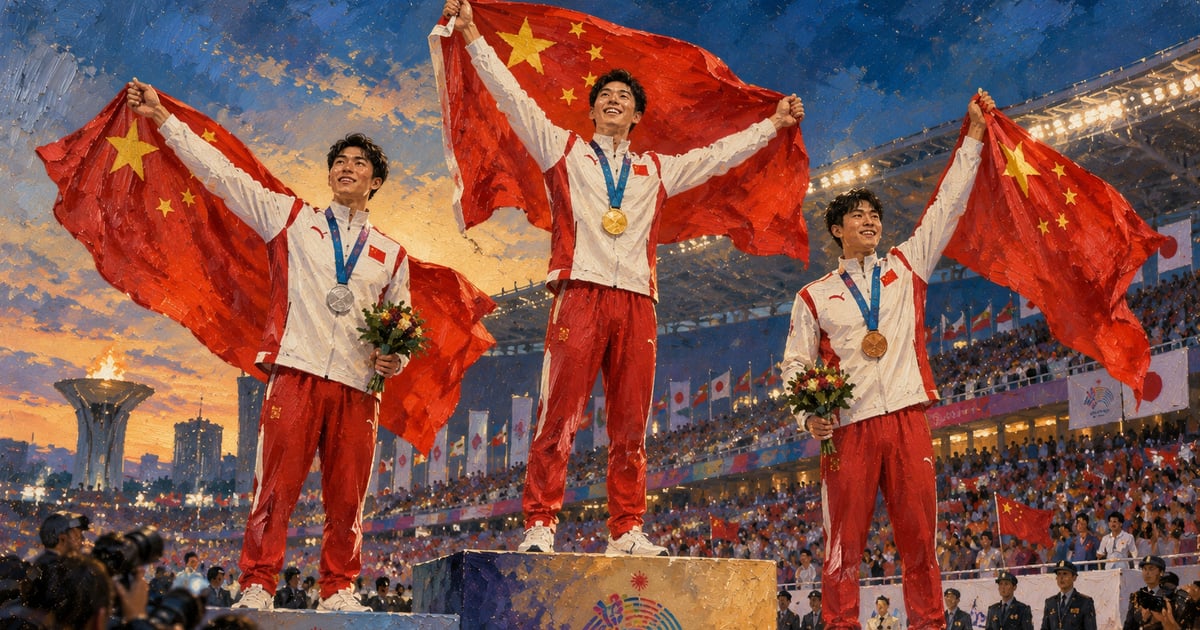
When Chinese athletes stand atop the podium at the Olympic or Asian Games, international audiences witness the culmination of biomechanical precision, intense physical discipline, and national pride.
Behind that spectacle, however, sits a finely tuned financial machine. China’s sports dominance is not sustained by ideological fervour or conventional municipal taxes alone; it is fuelled by an $87 billion state-run gambling enterprise. Every time an office worker in Shenzhen buys a 20-yuan scratch card, or a football fan in Chengdu wagers on the Premier League, a fraction of their money flows into high-altitude training dormitories in Qinghai, youth gymnastic pits in Hubei, and community exercise bars across 600,000 villages.
The China Sports Lottery remains the hidden fiscal engine of the modern Juguo Tizhi—a market-driven lottery empire sustaining an authoritarian Olympic machine.