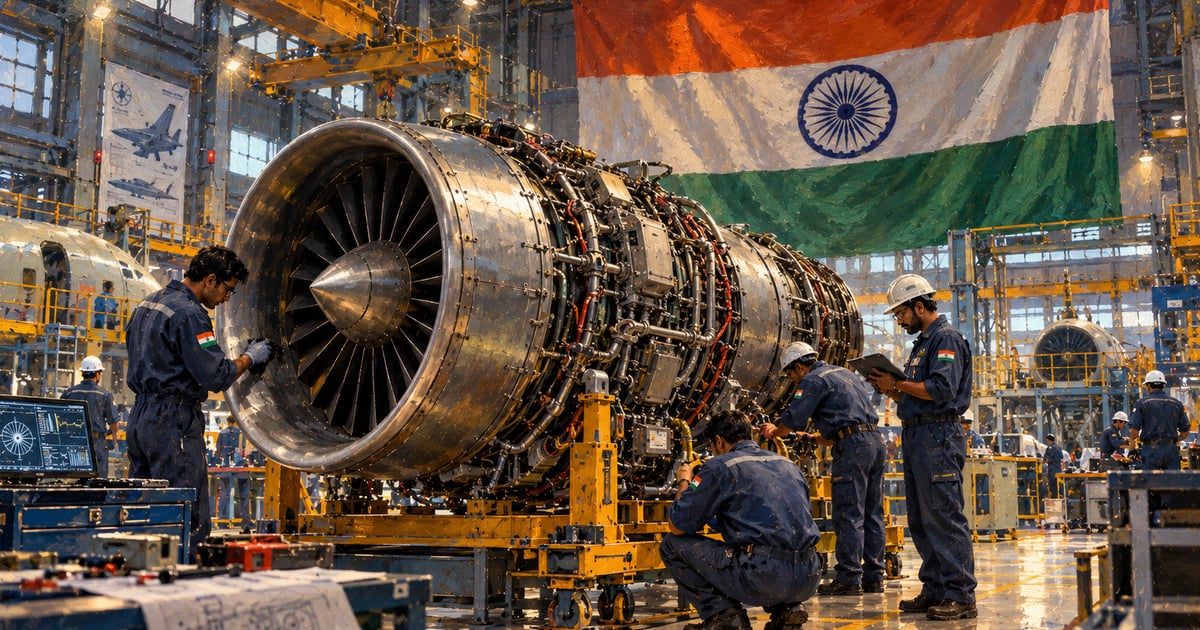
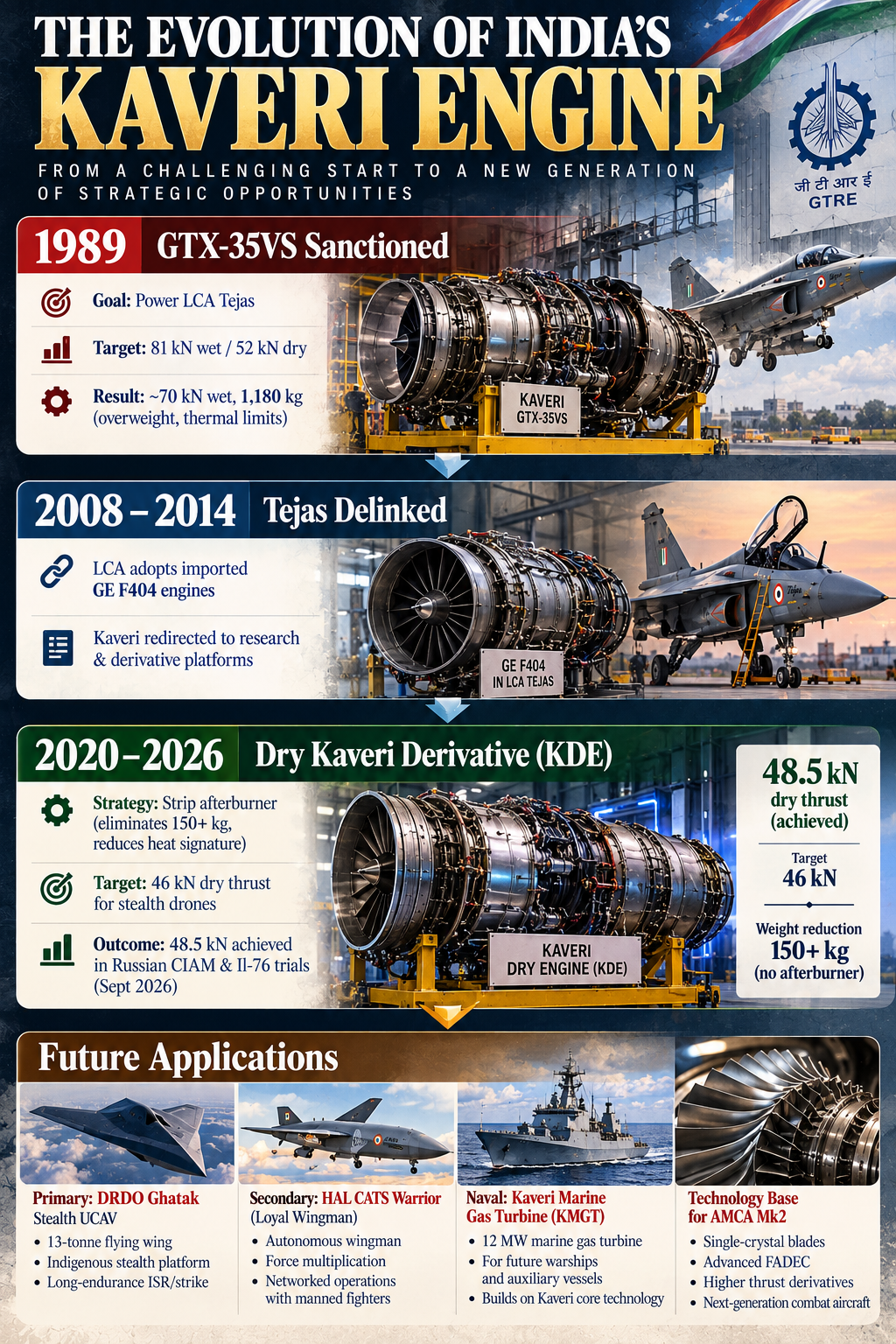
India’s four-decade effort to build an indigenous military turbofan has achieved its most concrete operational milestone. In late September 2026, defence sources confirmed that the non-afterburning derivative of the Kaveri aero-engine completed an intensive series of high-altitude simulated tests and airborne trials in Russia, generating a peak dry thrust of 48.5 kilonewtons (kN). The figure surpasses the project’s baseline requirement of 46 kN by more than 5%.
Developed by the Gas Turbine Research Establishment (GTRE)—a Bengaluru laboratory under the Defence Research and Development Organisation (DRDO)—the engine has shed the temperamental afterburning hardware that once doomed its inclusion on the Light Combat Aircraft (LCA) Tejas. By pivoting to a "dry" architecture, Indian propulsion engineers have delivered a power plant tailored for subsonic long-endurance flight.
The immediate beneficiary is the Ghatak programme, India’s classified 13-tonne autonomous stealth Unmanned Combat Aerial Vehicle (UCAV). Yet the operational consequences reach further, providing an indigenous baseline for loyal wingman drones, cruise missile propulsion, naval turbines, and the industrial manufacturing supply chains required for India's fifth-generation fighter ambitions.
What Happened During the Russian Trials?
Aero-engines cannot be validated on ground-level static test stands alone. An engine must prove that its compressor does not stall when operating in thin, sub-zero air at 40,000 feet, and that its combustion chamber can relight reliably after flameout during sudden throttle movements.
Because India does not yet possess a fully operational domestic High Altitude Test Facility (HATF) or a heavy flying testbed aircraft, the GTRE team conducted the trials in Russia across two specialised institutions:
The Central Institute of Aviation Motors (CIAM): In altitude chambers, the dry Kaveri was subjected to simulated high-altitude flight profiles. Engineers dropped ambient intake pressures and temperatures to evaluate cold-soak engine starts, combustion stability, and thermal dissipation inside the turbine core.
The Gromov Flight Research Institute (GFRI) at Zhukovsky: Flight trials were carried out using a modified Ilyushin Il-76LL flying testbed. One of the aircraft's four standard Soloviev D-30KP turbofans was removed and replaced with the experimental dry Kaveri pod.
Carried beneath the Il-76LL wing, the engine was operated across varied airspeeds, Mach numbers, and altitudes. The tests evaluated throttle response, fuel scheduling handled by an indigenous Full Authority Digital Engine Control (FADEC) system, and structural vibration across the flight envelope. Recording 48.5 kN under these flight conditions demonstrates that the engine possesses aerodynamic margin to spare beyond its 46 kN design floor.
Why Abandoning the Afterburner Changed the Equation
To understand why the dry Kaveri succeeded where the original engine stumbled, one must examine the thermodynamic trade-offs of fighter aircraft design.
When the Kaveri project was formally sanctioned in 1989 with a budget of ₹382.81 crore (subsequently revised in 2010 to ₹2,105 crore, or roughly $250 million), its mandate was to power the single-engine LCA Tejas. Modern combat fighters require an afterburner—a duct downstream of the turbine where raw aviation fuel is sprayed directly into oxygen-rich exhaust gases to produce an acute, short-duration thrust boost for take-off, supersonic dash, and high-G combat turns.
The original GTX-35VS targeted 81 kN of wet (reheat) thrust and 52 kN of dry thrust. In practice, the engine managed only between 70 kN and 72 kN in reheat while weighing approximately 1,180 kg, exceeding its 1,100 kg weight budget. The design ran up against severe thermal limits: the turbine blades degraded under the extreme turbine entry temperatures (TET), the compressor suffered pressure-ratio mismatches during dynamic airflow variations, and the complex variable-area exhaust nozzle added substantial dead weight. Consequently, the Ministry of Defence officially delinked the Kaveri from the Tejas in 2008, selecting the American General Electric F404-IN20 (85.4 kN wet) for Tejas Mark 1 and Mark 1A, and later the GE F414-GE-INS6 (98 kN wet) for Tejas Mark 2.
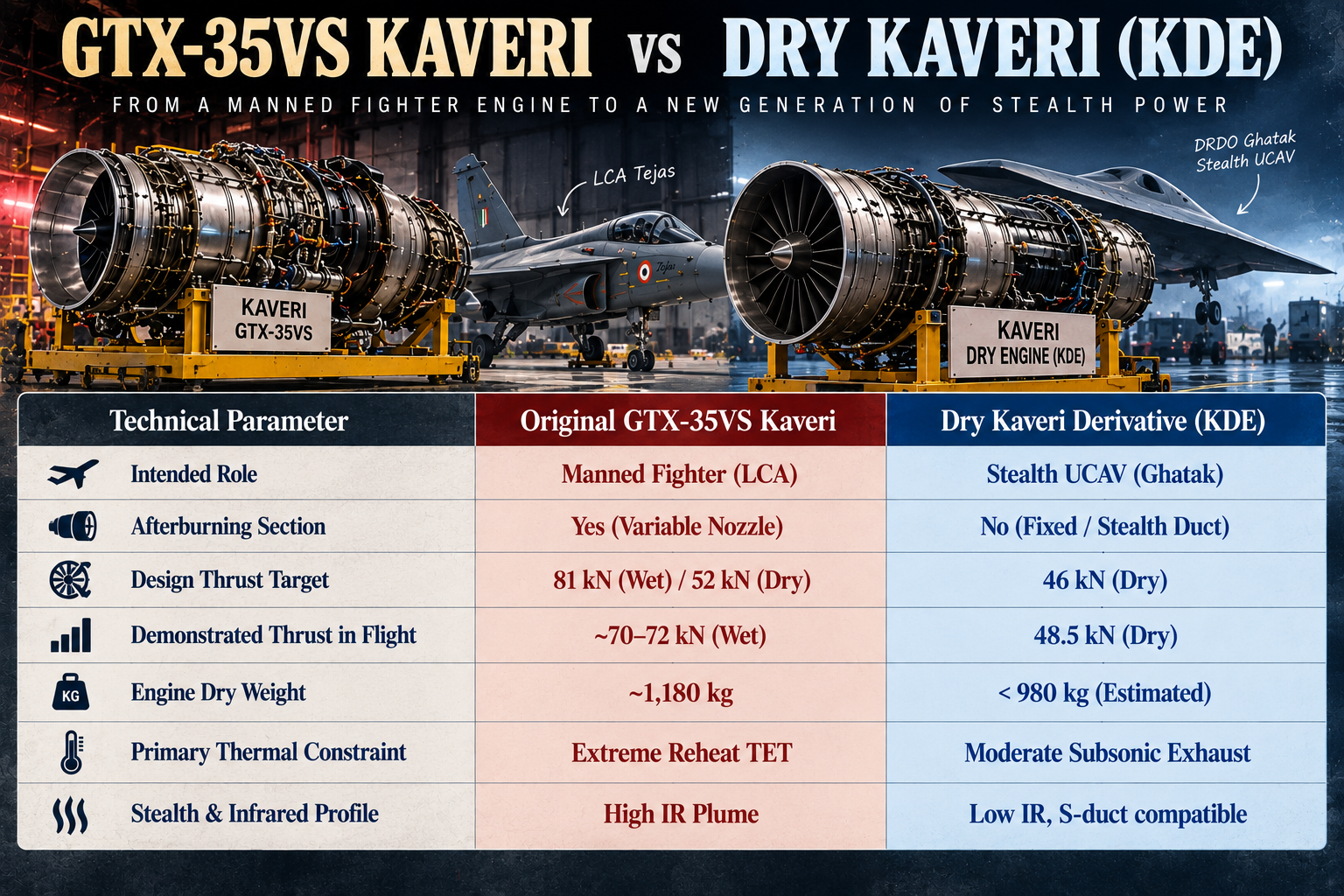
Removing the afterburner transforms the machine. By eliminating the reheat combustor, flameholders, fuel spray rings, cooling liners, hydraulic nozzle actuators, and variable petal assemblies, engineers shaved off between 150 kg and 200 kg of mass.
More importantly, it relieved the hot section of the engine from the extreme thermal stresses required during afterburner light-up. A dry turbofan runs cooler, consumes far less fuel per hour of operation, and features an inherently more predictable pressure gradient across the turbine stages. For subsonic applications, it is a mechanically simpler, more reliable engine.
The Primary Beneficiary: The Ghatak Stealth UCAV
The dry Kaveri is not an orphan powerplant searching for a platform. It has been custom-tailored to power Ghatak, India’s autonomous deep-penetration unmanned strike aircraft.
Developed by the Aeronautical Development Agency (ADA) and DRDO, Ghatak is a tailless flying-wing aircraft with an internal weapons bay, designed to slip through radar coverage, strike high-value fixed targets, and return autonomously.
In a stealth flying-wing drone, an afterburner is an operational liability:
Radar Cross-Section (RCS): A flying wing relies on smooth shaping and curved, serpentine air intake ducts (S-ducts) to shield the spinning compressor blades from enemy radar. An afterburner requires a straight, wide exhaust duct and mechanical nozzle petals that scatter radar reflections.
Infrared Signature: Reheat ignition produces an intense thermal bloom easily detected by ground-based infrared search and track (IRST) systems and heat-seeking air defence missiles. A dry engine allows the exhaust to be flattened into a two-dimensional nozzle embedded within the upper trailing edge of the airframe, mixing cold ambient bypass air with core exhaust to suppress its heat signature.
Endurance: Stealth strike drones need loiter capability. Afterburning engines consume fuel at three to four times the rate of dry cruise, drastically limiting combat radius.
The aerodynamic validity of Ghatak’s flying wing was proven at subscale between 2022 and 2023 by the Stealth Wing Flying Testbed (SWiFT), which flew successful autonomous missions at the Aeronautical Test Range in Chitradurga. However, SWiFT was a 1-tonne demonstrator powered by a commercial Russian NPO Saturn 36MT small turbofan generating just 4.4 kN of thrust. The full-scale Ghatak will displace between 13 and 15 tonnes. The 48.5 kN dry Kaveri matches the exact thrust bracket required to lift and sustain this production platform.
Wider Defence Projects Unlocked by the Milestone
While Ghatak stands first in line, the certification of a sovereign 48.5 kN gas turbine establishes capabilities across India's defence ecosystem:
1. Loyal Wingman and Manned-Unmanned Teaming (MUM-T)
The Indian Air Force's future doctrine integrates manned fighters like the Su-30MKI and Tejas with unmanned escorts under the Combat Air Teaming System (CATS). Platforms such as the HAL CATS Warrior—designed for autonomous reconnaissance, electronic warfare, and precision strikes ahead of manned packages—require compact, low-bypass turbofans in the 40–50 kN class. Relying on foreign engines for high-volume, attritable combat drones introduces export-control vulnerabilities. The dry Kaveri provides an ITAR-free domestic alternative.
2. The Kaveri Marine Gas Turbine (KMGT)
Aircraft engines can be marinised by replacing lightweight aerospace alloys with corrosion-resistant coatings, adding a power turbine, and adapting the core for naval fuel. GTRE has already demonstrated the Kaveri Marine Gas Turbine (KMGT), running tests at the Naval Dockyard in Visakhapatnam to deliver 12 megawatts (MW) of shaft power at standard naval operating conditions. With further marinisation, dry Kaveri cores can power auxiliary generators or propulsion drives for Indian Navy corvettes and offshore patrol vessels.
3. Long-Range Strike and Cruise Missiles
Heavy subsonic land-attack cruise missiles and anti-ship cruise platforms requiring ranges exceeding 1,000 kilometres rely on small, fuel-efficient turbofan engines. Scaling down the combustion and aerodynamic know-how from the dry Kaveri feeds directly into DRDO’s Indigenous Technology Cruise Missile (ITCM) and Long Range Land Attack Cruise Missile (LRLACM) propulsion units (such as the Manik engine).
4. Technical Foundations for AMCA Mark 2
The dry Kaveri will not power India's fifth-generation Advanced Medium Combat Aircraft (AMCA); AMCA Mark 1 will enter service with imported GE F414s, while AMCA Mark 2 requires an entirely new 110–120 kN afterburning engine planned under a joint development partnership with Safran or Rolls-Royce. However, the Kaveri programme created the domestic technical baseline without which no foreign manufacturer would negotiate meaningful co-development:
Single-Crystal Turbine Blades: Perfected by the Defence Metallurgical Research Laboratory (DMRL), nickel-based single-crystal blades operate at temperatures exceeding the melting points of conventional alloys.
Domestic Precision Manufacturing: Indian private industry now manufactures complete core modules. Godrej Aerospace, for instance, delivered indigenously fabricated dry Kaveri modules under contract from GTRE, shifting aero-engine manufacturing out of an exclusively state-run domain.
The Road Ahead: Certification and Prototype Integration
Despite the successful trials in Russia, several steps remain before the engine enters operational service.

First, telemetry data from the Russian trials must undergo formal scrutiny by India’s Centre for Military Airworthiness and Certification (CEMILAC). CEMILAC must verify safety margins, structural resonance, oil scavenging at high G-angles, and FADEC software fail-safes before issuing flight-clearance certification.
Second, the engine must be installed in an actual Ghatak airframe for ground taxi tests. Integrating an engine into an unmanned flying wing introduces complex aeromechanical interactions: the engine must operate behind an S-duct intake without air distortion causing compressor stall, and exhaust heat must be managed within internal airframe bays without scorching composite structures.
Finally, long-term testing must validate the engine's Mean Time Between Overhauls (MTBO). Global military engines operate for 1,000 to 2,000 hours between major overhauls; early Kaveri prototypes required tear-downs after a few hundred hours. Demonstrating component durability in serial production will determine whether the engine can sustain fleet operations.
A Perspective on Military Aeropower
Fewer nations have designed and built operational military jet engines from scratch than have detonated nuclear weapons or sent probes to Mars. Across the United States, Russia, the United Kingdom, and France, every modern aero-engine family has required decades of cumulative investment, thousands of flight-test hours, and substantial public capital. France’s Snecma M88 (which powers the Rafale) and the Eurojet EJ200 both consumed well over ₹16,000 crore to ₹25,000 crore ($2 billion to $3 billion) in dedicated R&D before achieving operational maturity.
India’s total expenditure on the entire Kaveri line across four decades stands at approximately ₹2,800 crore ($335 million)—a modest figure in global gas turbine engineering.
The 48.5 kN result in Russia does not erase past project management delays or restore an indigenous engine to the LCA Tejas. But by matching realistic engineering parameters to an aircraft that actively needs its specific performance profile, the dry Kaveri project has shifted the narrative. India's quest for aero-engine self-reliance is no longer trapped in the past; it has found its mission in the unmanned skies of the future.