For decades, the geopolitical narrative surrounding the South China Sea was entirely predictable. Beijing would assert its sweeping, unilateral claims via the "Nine-Dash Line," deploy its massive maritime militia to bully its neighbours, and construct artificial island fortresses. Meanwhile, the rest of the world watched from a distance, relying on standard diplomatic protests and periodic U.S. naval patrols to keep the waters free.
But a massive shift is underway, and it isn’t coming from Washington. It’s coming from New Delhi.
Driven by intense land-border frictions with Beijing, India has completely abandoned its traditional posture of cautious neutrality. Through a bold geopolitical blueprint known as "Arming the Periphery," India is fundamentally altering the balance of power in China’s backyard.
The Core Problem: The Nine-Dash Line Dictatorship
To understand why India's new strategy matters, you have to look at what it is pushing back against. Beijing claims historical sovereignty over roughly 80% to 90% of the South China Sea, completely ignoring the internationally recognised 200-nautical-mile Exclusive Economic Zones (EEZs) of nations like the Philippines, Vietnam, and Indonesia.
Rather than launching a conventional military invasion, China has used "grey-zone coercion"—incremental, aggressive steps that stop just short of triggering war. They have built seven massive artificial islands equipped with missile batteries and packed the sea with a permanent "Maritime Militia" of reinforced fishing hulls to choke out local fishermen and oil drillers.
For the smaller Southeast Asian nations bordering the sea, matching China’s sheer naval size is an impossibility.
Enter the "Porcupine Strategy"
India’s response is brilliant in its asymmetry. Instead of sailing the Indian Navy deep into the South China Sea to pick a direct fight with Beijing, India is turning China's neighbours into geopolitical porcupines.
The strategy is simple: equip smaller littoral nations with high-tech, lethal defence hardware. They might not be able to defeat the Chinese Navy in an open ocean war, but they can make any act of aggression or intimidation far too painful and costly for Beijing to sustain.
Asymmetric Deterrence: You don't need to match an adversary ship-for-ship if you possess the shoreline capability to sink their most advanced vessels from hundreds of miles away.
The Spearhead: BrahMos Diplomacy
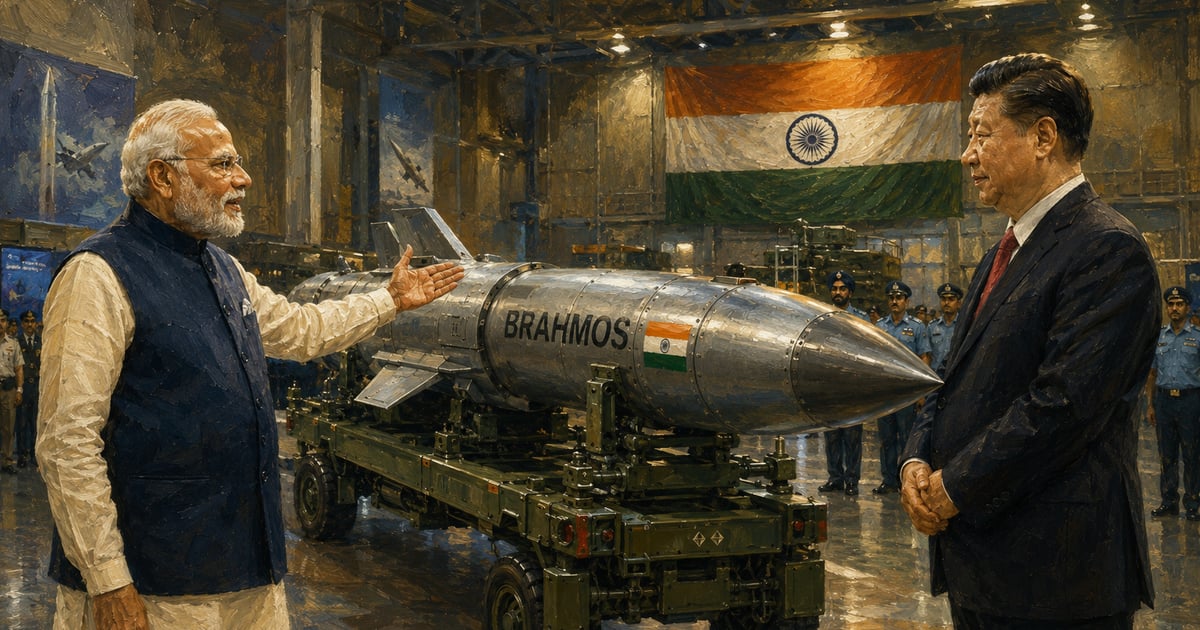
The crown jewel of India’s periphery strategy is the BrahMos supersonic cruise missile. Developed jointly with Russia, the BrahMos travels at nearly three times the speed of sound (Mach 3.0) and flies mere meters above the waves to completely evade enemy radar. It is widely considered one of the deadliest anti-ship cruise missiles in existence.
India is systematically distributing this capability across the front lines of the South China Sea:
The Philippines: As the first nation to take delivery of India’s shore-based BrahMos batteries, the Philippine Marine Corps now holds the capability to strike Chinese vessels encroaching deep inside its EEZ.
Indonesia: Jakarta has locked in a major strategic defence contract for both land- and naval-variant BrahMos systems, alongside India's advanced Astra air-to-air missiles, explicitly designed to secure its vital maritime chokepoints.
Vietnam: Backed by hundreds of millions of dollars in Indian defence credit lines, Hanoi is actively upgrading its coastal defences with Indian missile systems and patrol boats.
The Ultimate Strategic Checkmate
By arming these front-line nations, India forces Beijing into a severe multi-front dilemma. If China chooses to escalate tensions along its disputed Himalayan land border with India, it must now factor in that its vital commercial lifelines in the South China Sea are surrounded by nations armed with lethal Indian missiles.
Furthermore, India holds a geographic trump card at the western gateway to the South China Sea: the Andaman and Nicobar Islands.
Sitting directly at the mouth of the Malacca Strait—the narrow corridor through which China imports roughly 80% of its oil—India is aggressively transforming these islands into a heavily fortified maritime strike platform. In a crisis, the Indian Navy has the structural capability to simply turn off the energy faucet feeding the Chinese economy.
The Bottom Line
The era of India acting as a passive bystander in Southeast Asia is officially over. By transitioning from a major arms importer into a sharp, decisive defense exporter, New Delhi has established itself as a true regional security provider.
By drawing a hard line against the Nine-Dash Line and giving teeth to the nations resisting it, India is ensuring that the South China Sea remains contested, open, and far more dangerous for any single superpower to dominate.