In brief
- India’s retail inflation rose to 6.09 per cent year on year in October 2026, breaching the RBI’s 6 per cent upper tolerance for the first time in two years and complicating the policy path ahead of the December rate review.
- MoSPI data show the October rise came from a deficient monsoon, triple digit onion inflation and an unfavourable base, with October inflation the highest under the 2024=100 base series.
- Food inflation jumped 8.94 per cent in October, as onion prices surged 116.22 per cent year on year, and other vegetables and spices also saw sharp increases.
- The RBI had already begun tightening by raising the policy repo rate to 5.50 per cent at its October meeting, shifting from neutral to calibrated tightening, ahead of the December review.
India’s retail inflation breached the Reserve Bank of India’s (RBI) upper tolerance ceiling of 6% in October 2026 for the first time in two years, complicating the central bank’s policy path just three weeks before its December rate review.
Data released on 12 November by the Ministry of Statistics and Programme Implementation (MoSPI) showed Consumer Price Index (CPI) inflation rose to 6.09% year-on-year, accelerating from 5.54% in September and exceeding the Reuters poll consensus of 5.93%. It marks the ninth consecutive monthly increase since January 2026 (2.74%) and the highest reading recorded under the revamped 2024=100 CPI base series.
Under India’s flexible inflation-targeting framework—reaffirmed by New Delhi in March 2026 through March 2031—the RBI is mandated to keep retail inflation at 4%, within a tolerance band of 2% to 6%. Crossing the upper boundary does not trigger an immediate statutory failure (which requires three consecutive quarters above 6%), yet it places unmistakable pressure on Governor Sanjay Malhotra and the Monetary Policy Committee (MPC) ahead of their 2–4 December 2026 meeting.
The Anatomy of October’s 6.09% Print
While headline figures capture attention, the underlying MoSPI breakdown reveals that price pressures are neither uniform across geography nor confined solely to one or two vegetables.
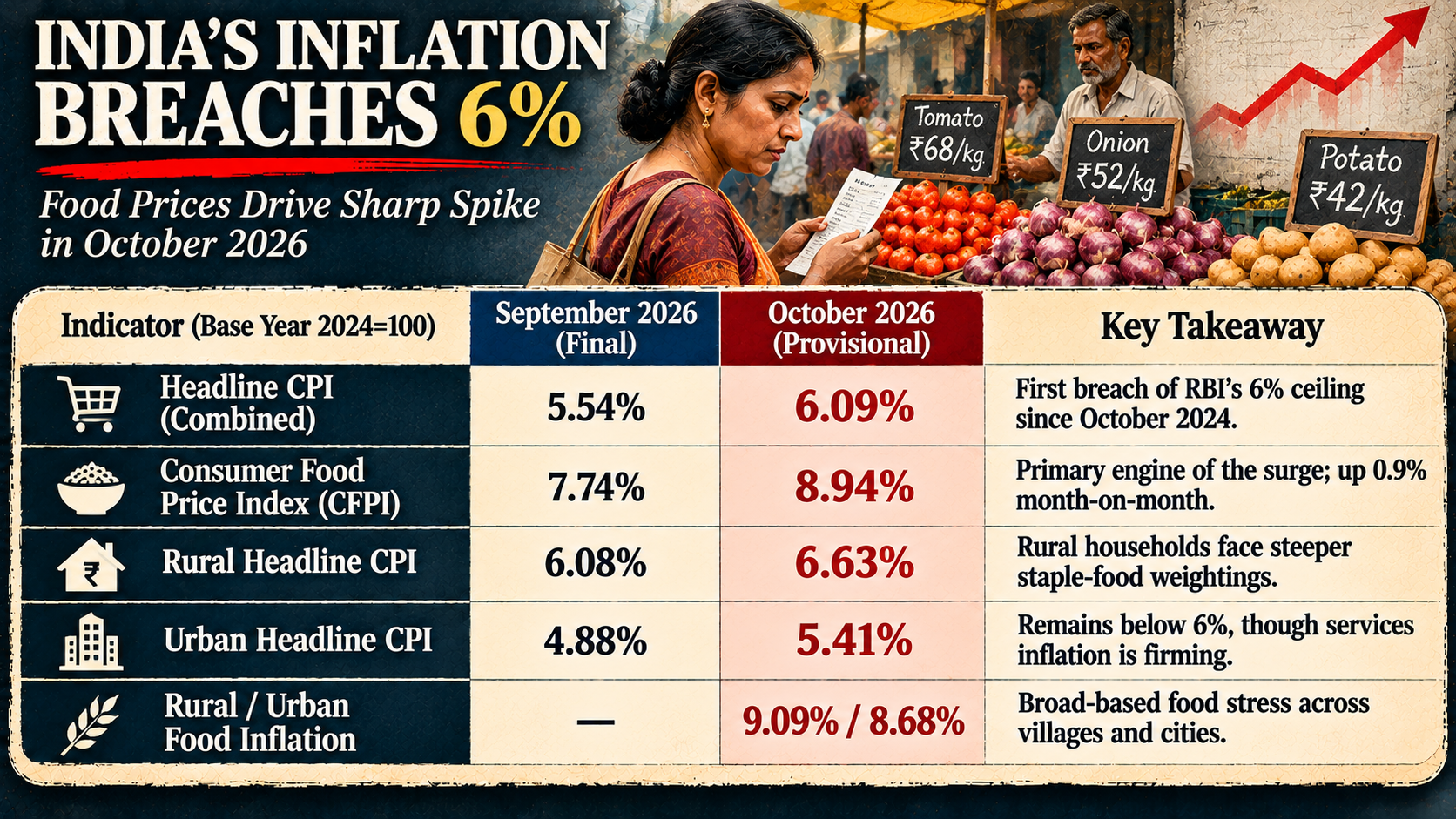
Geographically, southern states absorbed the sharpest price shock. MoSPI state-wise data showed Tamil Nadu recording the highest headline inflation among large states at 7.29%, followed closely by Telangana (7.26%), Andhra Pradesh (7.25%), Madhya Pradesh (7.19%), and Odisha (7.17%). On food inflation alone, Andhra Pradesh surged to 13.23%, ahead of Tamil Nadu (12.37%), Karnataka (12.16%), and Telangana (11.66%).
Why Did Inflation Cross the Band? Four Converging Drivers
October’s breach reflects the collision of agricultural weather shocks, an unfavourable statistical base, global commodity spillovers, and delayed corporate pass-through.
1. Monsoon Deficit, El Niño, and Vegetable Spikes
The immediate trigger was food inflation jumping 120 basis points in a single month to 8.94%. India’s 2026 south-west monsoon ended 12.6% below normal, compounded by strengthening El Niño conditions that disrupted kharif harvests and vegetable supply chains across peninsular India.
According to MoSPI’s item-level release, onion prices soared 116.22% year-on-year, more than doubling from October 2025 levels. Sharp increases were also recorded in garlic (+60.74%), ginger (+48.32%), and lemon (+47.30%). Although potatoes (-14.24%), cauliflower (-10.57%), and brinjal (-3.34%) registered price declines, they were far too modest to offset the broader kitchen-budget shock.
2. The Statistical Base Effect
Part of October’s steep climb is mathematical. In October 2025, India recorded an unusually depressed CPI print of just 0.25%—a near-zero baseline. Measuring October 2026 prices against that depressed base naturally exaggerates the annual percentage rate, even though sequential month-on-month headline prices rose a more moderate 0.5% (and food 0.9%).
3. Broadening Core and Services Pressures
Crucially, inflation is no longer purely a vegetable story. Non-food categories showed steady sequential firming:
Personal care and related items (which include precious metals) rose 10.14%, with silver jewellery up 52.39% (though down from 87.82% in September).
Restaurants and accommodation services climbed 10.06%, reflecting pass-through from higher commercial food and wage costs.
Transport rose 5.84%, while fast-moving consumer goods (FMCG) companies have begun passing on delayed input-cost increases across milk, ghee, soaps, and cigarettes, alongside seasonal increases in clothing and vehicle prices.
4. Geopolitical Energy and Currency Spillovers
Earlier in 2026, renewed conflict in West Asia lifted global crude oil and freight rates, putting downward pressure on the rupee and keeping wholesale input-price inflation near 9% year-on-year. Even though global crude prices have softened somewhat in recent weeks on diplomatic hopes, economists note that prior energy and industrial cost increases are still feeding through to retail goods and services.
What Lies Ahead: The RBI’s Dilemma and Rate Outlook
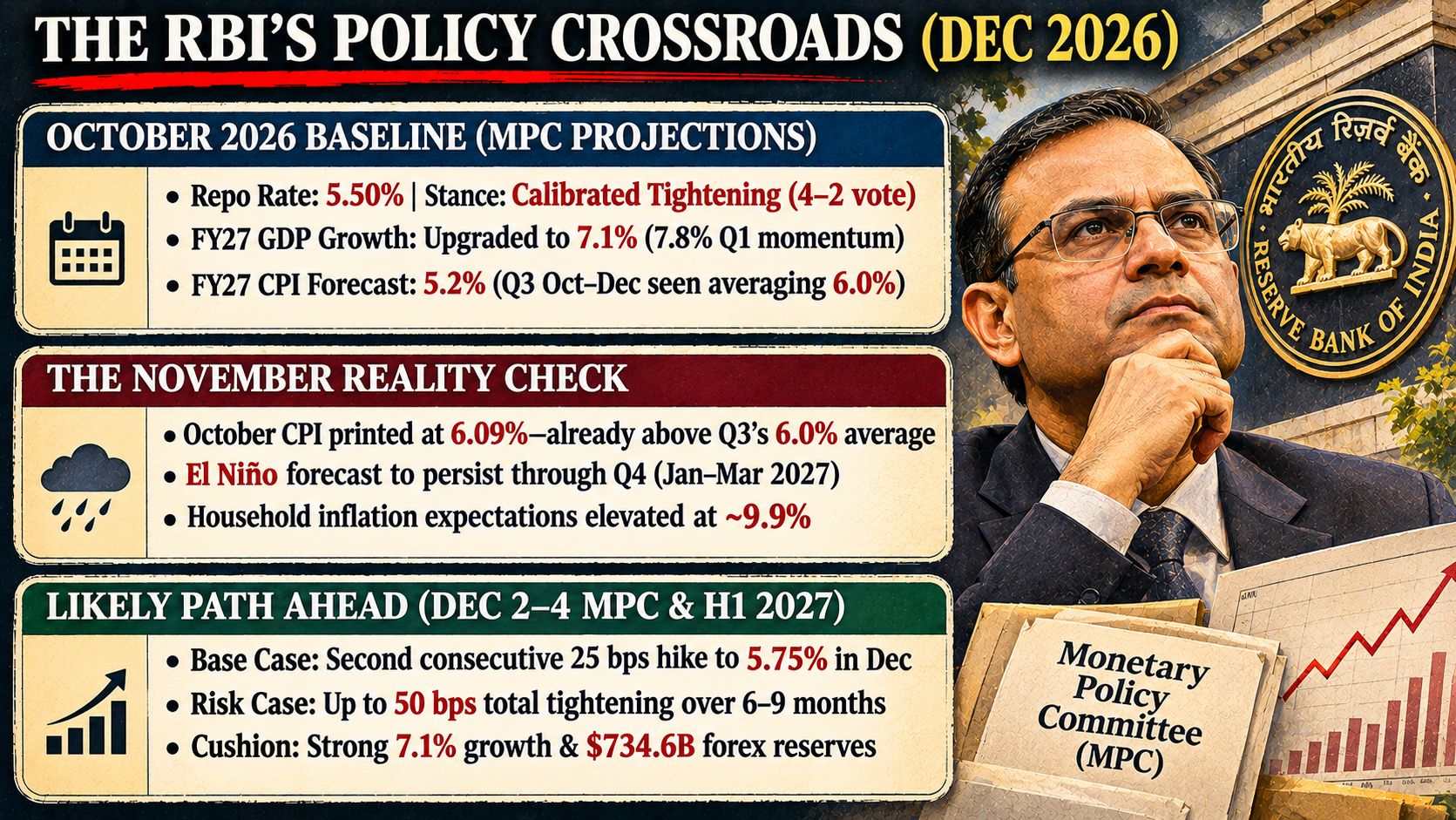
Unlike previous inflation spikes where the central bank was caught on an easing bias, the RBI had already moved pre-emptively. At its 63rd MPC meeting on 5–7 October 2026, the committee voted unanimously (6–0) to raise the policy repo rate by 25 basis points to 5.50%—its first hike since February 2023—and shifted its policy stance from "neutral" to "calibrated tightening" (4–2 vote).
In the minutes published on 21 October, the MPC explicitly stated that rate cuts were off the table in the near term, warning that future moves could only be a hike or a pause.
Several factors point toward sustained monetary vigilance over the next two quarters:
Revised Forecasts Likely: The RBI’s October projections assumed Q3 FY27 (October–December) inflation would average 6.0% before easing to 5.7% in Q4. With October already at 6.09% and an unfavourable base persisting, analysts expect the MPC to revise its quarterly inflation projections upward in December.
Market Consensus on December Rate Action: Following the 12 November release, economists polled by Reuters flagged expectations of a second successive 25 bps repo rate hike at the 2–4 December meeting, with some forecasting up to 50 bps of cumulative tightening over the next six to nine months if inflation remains near or above 6% through mid-2027.
The Three-Quarter Watchlist: In a November 2026 market outlook, SBI Mutual Fund cautioned that headline CPI could average nearly 5.8% over the next three quarters with a material risk of breaching 6%, citing El Niño’s impact on winter sowing, delayed FMCG price hikes, and potential retail fuel adjustments if crude rebounds.
What It Means for Households, Borrowers, and Markets
For Indian households and businesses, the macroeconomic trade-off is straightforward: strong domestic growth is giving the RBI room to prioritise inflation control.
With first-quarter FY27 GDP expanding at 7.8%, full-year growth projected at 7.1%, and foreign exchange reserves standing at a comfortable $734.6 billion (as of early October), the central bank does not face an immediate growth emergency.
Borrowers: Individuals with floating-rate home, auto, or MSME loans linked to external benchmarks (such as the repo rate) should prepare for higher Equated Monthly Instalments (EMIs) or extended loan tenures at upcoming reset cycles if the MPC hikes to 5.75% in December.
Savers: Fixed-deposit (FD) investors stand to benefit as banks—amid tighter system liquidity management through Variable Rate Reverse Repo (VRRR) auctions—keep deposit rates elevated to attract retail funding.
Consumers: Relief on kitchen budgets hinges on winter rabi vegetable arrivals from late November onwards. While fresh potato and seasonal produce may cool prices marginally in December, persistent El Niño weather patterns mean food inflation is unlikely to return swiftly to the RBI’s 4% comfort midpoint before the second half of 2027.