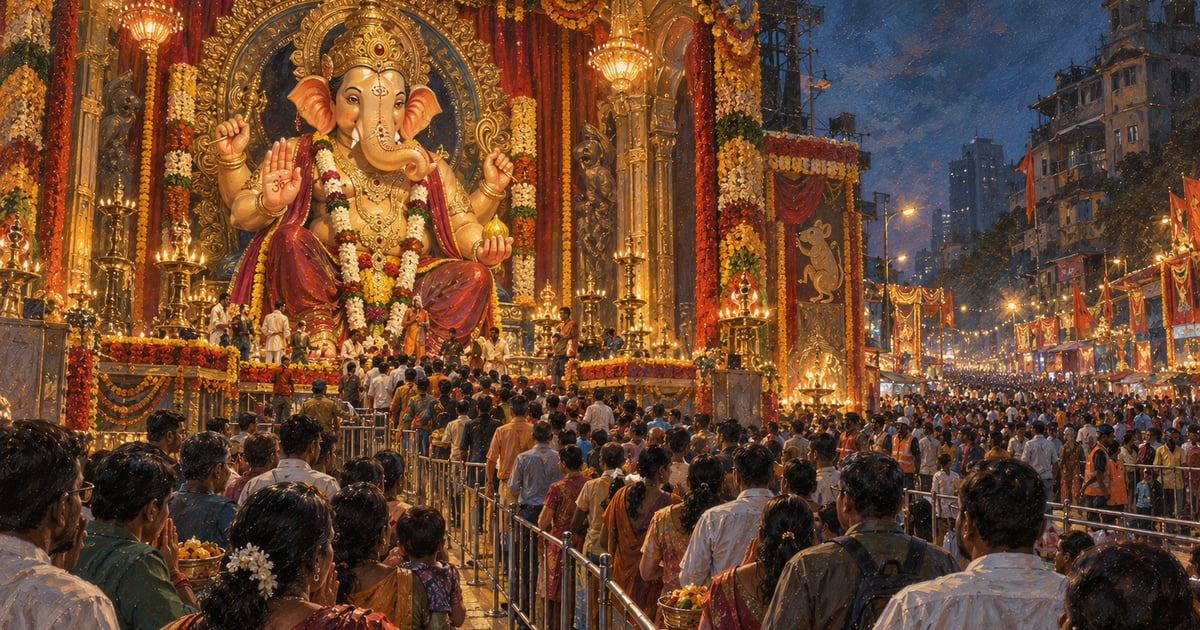
Every autumn, the arrival of Ganeshotsav transforms Mumbai into an amphitheatre of devotion, spectacle, and intense civic mobilisation. Streets are lined with elaborate marquees (pandals), percussion troupes rehearse late into the night, and millions of devotees gather to seek the blessings of Ganapati Bappa.
Yet alongside the spiritual fervour sits a sophisticated, high-stakes financial exercise. In September 2026, the GSB Seva Mandal at King's Circle in Matunga—widely regarded as Mumbai’s wealthiest Ganesh mandal—secured an unprecedented insurance cover of ₹703.27 crore (approximately $84 million) for its five-day celebration. The figure represents a 75% increase over its ₹400.58 crore cover taken in 2024 and outstrips its ₹474.46 crore policy in 2025.
While multi-crore covers for deity idols inevitably capture headlines, the financial reality behind the numbers is far more grounded. Rather than insuring divine grace, these bespoke policies reflect a maturing event insurance sector in India. Spurred by shifting legal liabilities, heightened weather volatility, and the professionalisation of event management, risk transfer mechanisms have expanded rapidly from temple trusts to luxury destination weddings, global stadium concerts, and premier sporting spectacles.
Deconstructing the ₹703 Crore Policy: What Is Actually Insured?
A common misconception is that a ₹700 crore festival policy is solely an insurance evaluation of gold and silver. While the idol of MahaGanapati at GSB Seva Mandal is indeed adorned with over 66 kilograms of gold and 335 kilograms of silver, the precious metals comprise only a fraction of the total exposure.
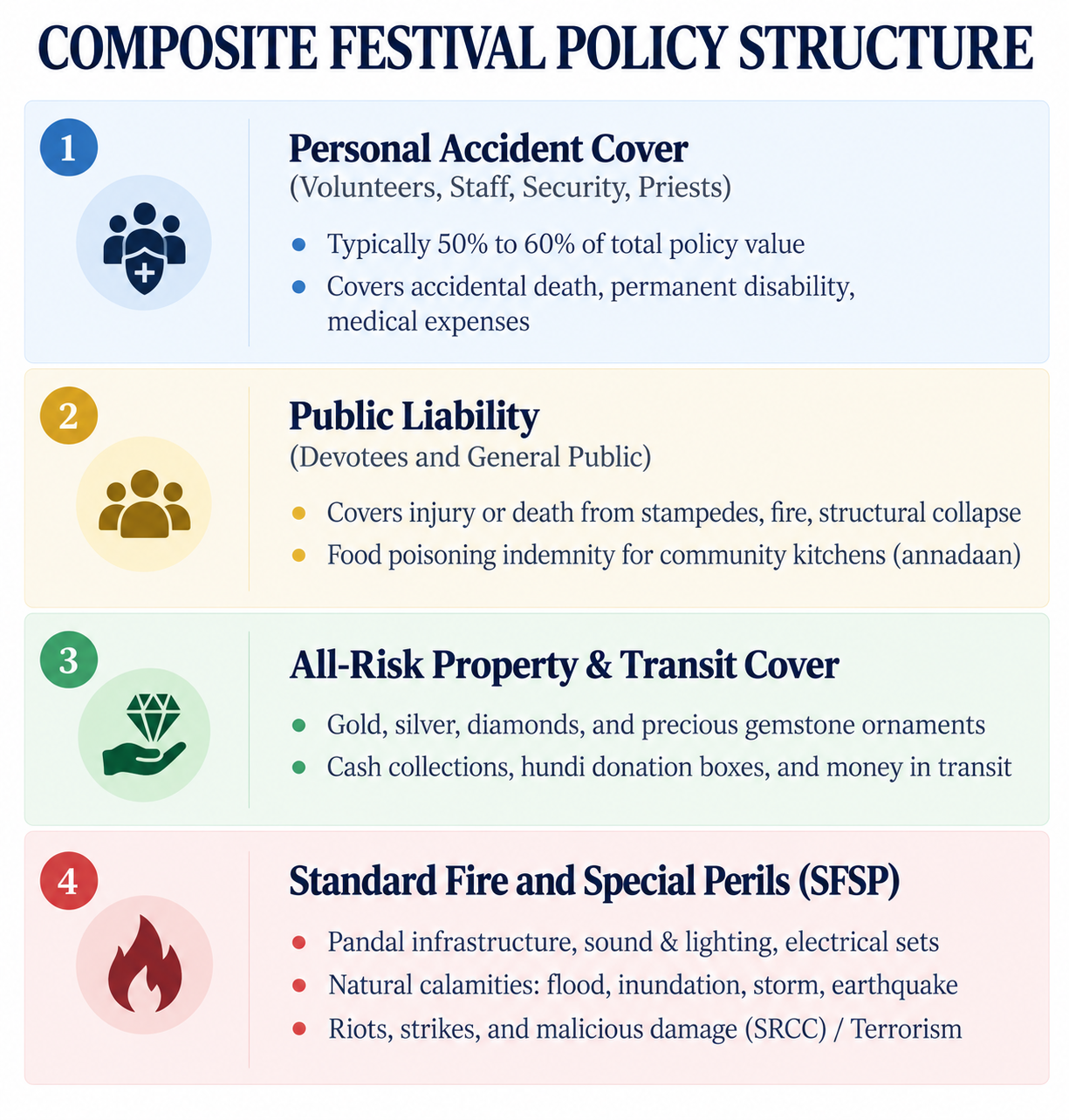
Festival policies designed by major state-backed underwriters—chiefly The New India Assurance and The Oriental Insurance Company—are composite multi-peril indemnity contracts. Their sum insured is weighted heavily towards human capital and third-party liabilities:
As Amit Pai, spokesperson for GSB Seva Mandal, explained to The Economic Times, the priority is community welfare:
"Being a responsible mandal, it is our responsibility to ensure the safety and security of every devotee."
With more than 40,000 people partaking in daily annadaan seva (food charity) and over 2 lakh devotees receiving prasad over five days, public liability clauses must explicitly include food-poisoning indemnity alongside standard crowd-surge protections.
A comparable model operates at Parel’s iconic Lalbaugcha Raja, which commands an annual cover ranging between ₹25 crore ($3 million) and ₹33 crore ($3.95 million). Despite housing millions in gold offerings, Lalbaugcha Raja's policy structure dedicates significant coverage to third-party public liability and volunteer accident compensation, reflecting the sheer density of its 24-hour charan sparsh (foot-touching) and mukh darshan queues that stretch for kilometres through central Mumbai.
The Democratisation of Festival Coverage: From Crores to Thousands
While premier mandals operate with corporate-scale administrative boards, the true sign of market maturity is the penetration of insurance into mid-tier and neighbourhood pandals.
Historically, community committees treated insurance as an unnecessary overhead, relying instead on volunteer marshals and local goodwill. However, heightened municipal regulations, stricter fire-safety compliance audits, and volatile weather patterns have catalysed a shift.
According to reporting by Business Standard, Oriental Insurance covered approximately 100 Ganpati pandals in 2026—a sharp increase from between 20 and 30 pandals in 2025. This uptick has been accelerated by an emerging trend of larger, well-funded trusts sponsoring group policies for smaller pandals across suburban wards.
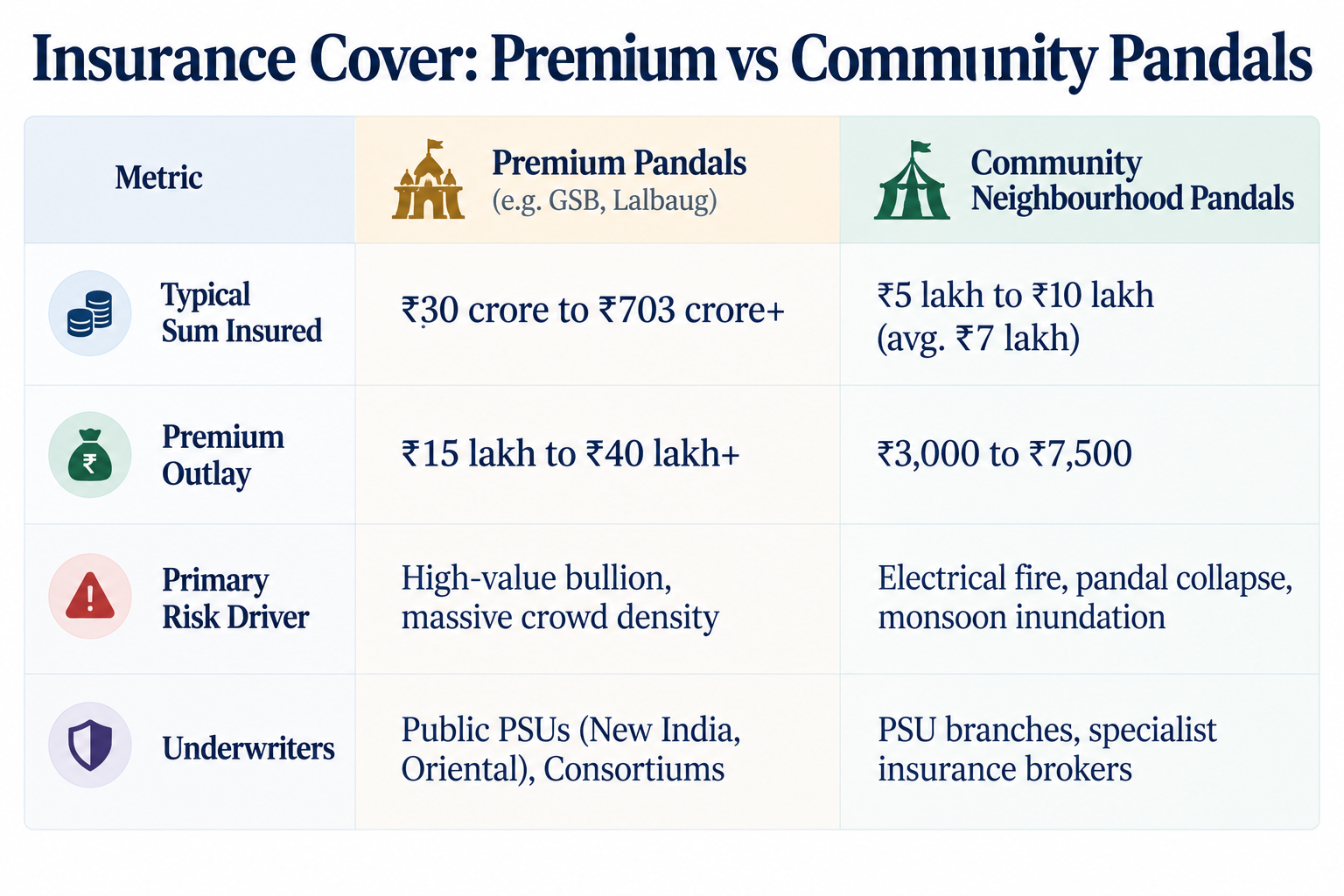
For smaller committees, insurers have engineered standardised micro-packages:
Hitesh Lakhani, Director at Investacc Insurance Brokers, noted the structural change in buyer behaviour:
"Amid the floods in Nepal and prediction of rains during Ganpati time by meteorological agencies, organisers are considering insurance as a risk mitigation tool. There is also an increase in awareness about insurance, and organisers are concerned about risks caused by natural calamities as well as those from riots, personal accidents and burglary."
This formalisation echoes the state-sponsored safety nets established during Krishna Janmashtami's Dahi Handi festivities. In 2026, Oriental Insurance covered 168,535 Govindas across 2,002 mandals—up from 160,000 participants in 2025. Backed by ₹1.12 crore from Maharashtra’s Sports Development Fund, the policy provided ₹10 lakh in personal accident cover for a nominal premium of ₹75 per participant, with hospitalisation allowances doubled to ₹2 lakh. The institutionalisation of high-risk festival activities has set an operational precedent that Ganpati committees and Durga Puja organisers are now actively adopting.
The Broader Landscape: India’s Expanding Event Insurance Ecosystem
Religious festivals are the most visible component of a broader transformation across India’s entertainment, cultural, and sports sectors. According to industry analyses by Mordor Intelligence, India’s exhibition and event management market was valued at $5.69 billion in 2025 and is projected to expand to $9.04 billion by 2031, compounding at over 8% annually.
As capital commitments per event escalate, event insurance has moved from an optional safeguard to a non-negotiable prerequisite for debt financing, venue licensing, and brand sponsorship.
1. Mega-Concerts and Live Entertainment
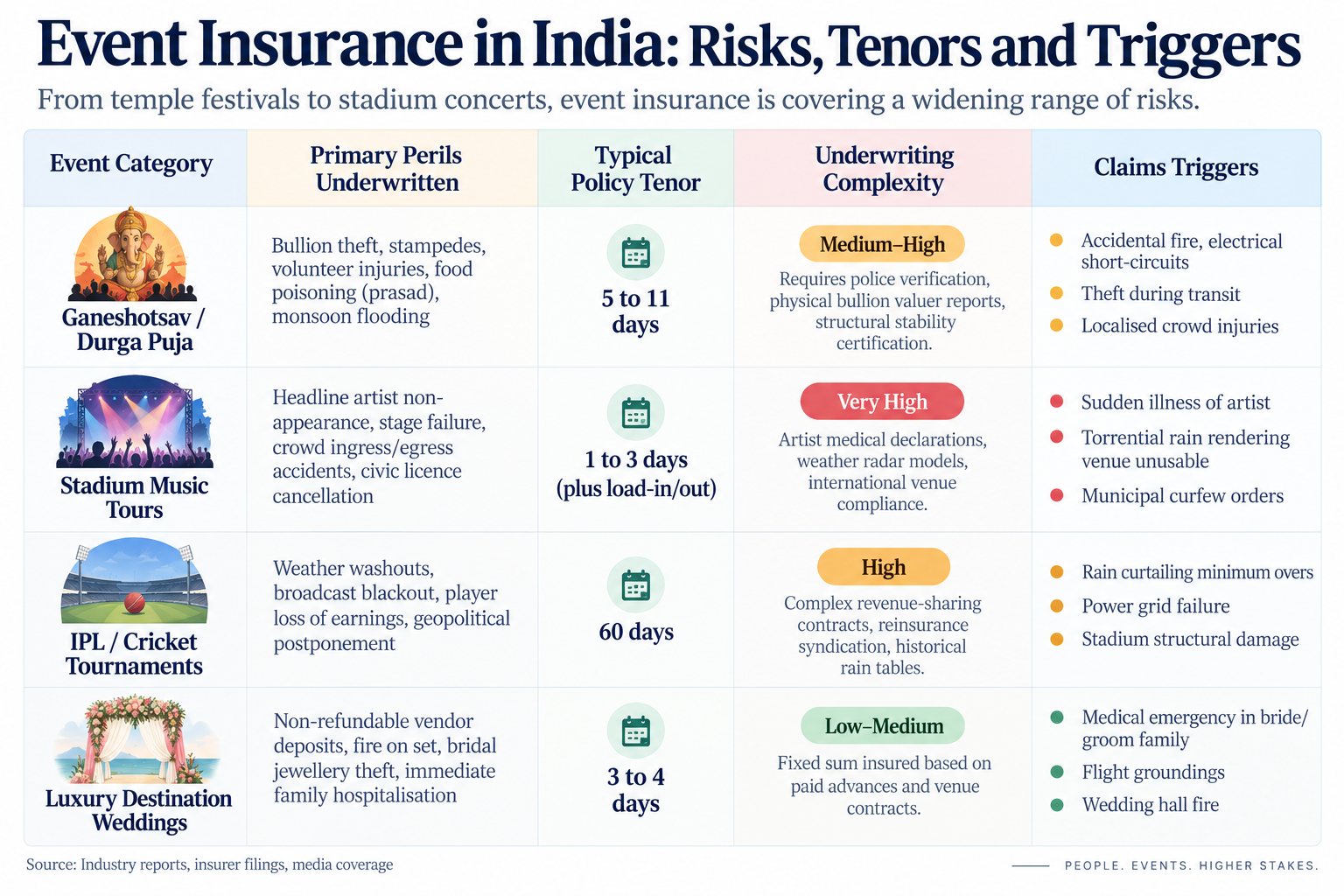
The influx of international stadium tours—such as Coldplay’s Music of the Spheres Tour in Mumbai, Diljit Dosanjh’s Dil-Luminati shows, and multi-city Lollapalooza editions—has introduced global underwriting standards to Indian promoters.
These productions require specialised contingency policies covering:
Artist Non-Appearance: Protection against catastrophic revenue loss if the headline act faces sudden illness, travel disruption, or bereavement.
Stage and Equipment All-Risk: Multi-crore covers for imported audiovisual gear, kinetic light rigs, and temporary staging during transit and erection.
Crowd Control & Structural Failure: High-limit public liability policies protecting promoters against litigation from crowd crushes, stampedes, or structural collapse.
2. High-Stakes Sports: The IPL Benchmark
The gold standard of event underwriting in India remains the Indian Premier League (IPL). Major editions routinely generate cumulative insurance covers exceeding ₹10,000 crore ($1.2 billion).
Spanning the Board of Control for Cricket in India (BCCI), broadcasters, franchise owners, and stadium authorities, IPL policies hedge against match abandonment, unseasonal monsoon washouts, transmission failures, player injuries, and geopolitical crises. The reinsurance treaties for these policies are typically syndicated through Lloyd’s of London syndicates and domestic reinsurer GIC Re, showcasing India’s capacity to handle global-scale contingent risk.
3. Big Fat Indian Weddings: Insuring the Uninsurable
India’s wedding industry is an economic juggernaut, generating between ₹4.25 lakh crore and ₹6 lakh crore ($72 billion) across roughly 48 lakh ceremonies annually, according to assessments by industry bodies and ICICI Lombard General Insurance.
With destination weddings in Rajasthan, Goa, and international hubs commanding budgets from ₹1 crore to upwards of ₹50 crore, families are increasingly procuring dedicated wedding insurance. Policies typically cover non-refundable venue advances, decorator defaults, sudden wedding cancellations due to the hospitalisation of immediate family, and theft of heavy bridal jewellery and designer trousseaus.
Underwriting Challenges and Structural Gaps
Despite triple-digit growth in policy issuance, India's event insurance market faces persistent friction points that complicate risk pricing:
1. Extreme Weather and Climate Risk
Historically, insurers relied on regional monsoon withdrawal schedules to price September event policies. However, erratic weather events—such as sudden cloudbursts, severe urban waterlogging, and delayed monsoon retreats—have disrupted traditional actuarial models.
Underwriters increasingly mandate pluviometer (rainfall measurement) clauses, establishing precise millimetre-per-hour thresholds before rain-related abandonment claims become payable.
2. The Force Majeure and Regulatory Gray Zone
A major point of contention between event organisers and underwriters involves governmental or regulatory cancellations. Standard policies routinely exclude cancellations resulting from:
Failure to obtain required municipal, traffic, or fire department No-Objection Certificates (NOCs).
Local law-and-order restrictions or political bandhs unless specific riot/strike endorsements (SRCC) are purchased.
Decibel-limit enforcement or noise-pollution crackdowns.
When regulatory bodies withdraw permissions due to administrative discretion, insurers often classify the incident as an uninsurable operational failure rather than an unforeseen peril, leaving organisers exposed to catastrophic sunk costs.
3. Crowd Dynamics and Underreported Liabilities
While Tier-1 mandals employ private security firms, CCTV arrays, and metal detectors, thousands of medium-sized gatherings struggle with crowd crush risks. Public liability limits in smaller policies (often capped at ₹10 lakh or ₹20 lakh) remain insufficient in the event of a severe stampede or structural marquee collapse. Bridging this underinsurance gap requires collective civic pooling mechanisms and mandatory minimum liability legislation for mass public assemblies.
Summary of Operational Insights
Human Safety Outweighs Material Assets: High-value festival insurance policies dedicate their largest coverage tranches to volunteer personal accident and third-party public liability rather than physical jewellery.
Micro-Insurance Drives Pandal Penetration: Accessible premium products (e.g., ₹7 lakh cover for ₹3,000) have democratised risk coverage for suburban and community pandals.
Institutional Convergence: The institutionalisation seen in sports leagues (IPL) and commercial concerts is cascading down into community trusts, wedding planning agencies, and local cultural committees.
Scrutiny on Exclusions: Organisers must review policy exclusions—particularly regarding municipal permits, unseasonal precipitation metrics, and food hygiene declarations—to ensure risk transfer matches practical operational exposures.