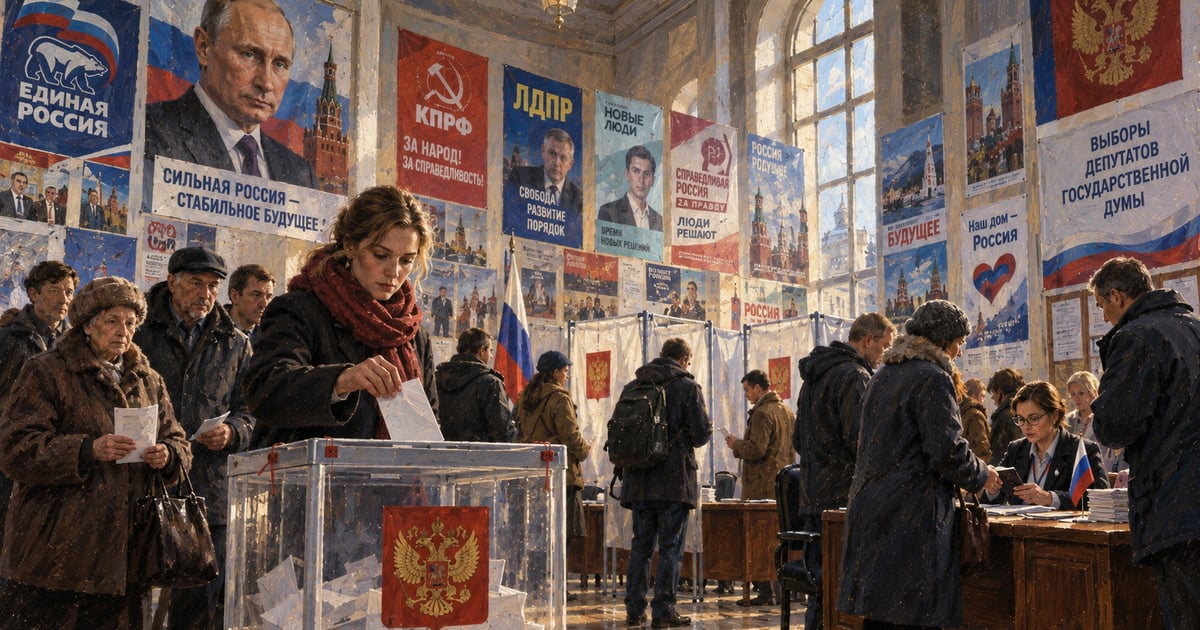
Between 18 and 20 September 2026, Russian voters are heading to the polls to elect the 450 deputies of the State Duma's 9th convocation. This represents the country's first national legislative contest since Vladimir Putin launched the full-scale invasion of Ukraine in February 2022, as reported in The Guardian’s coverage of the 2026 vote.
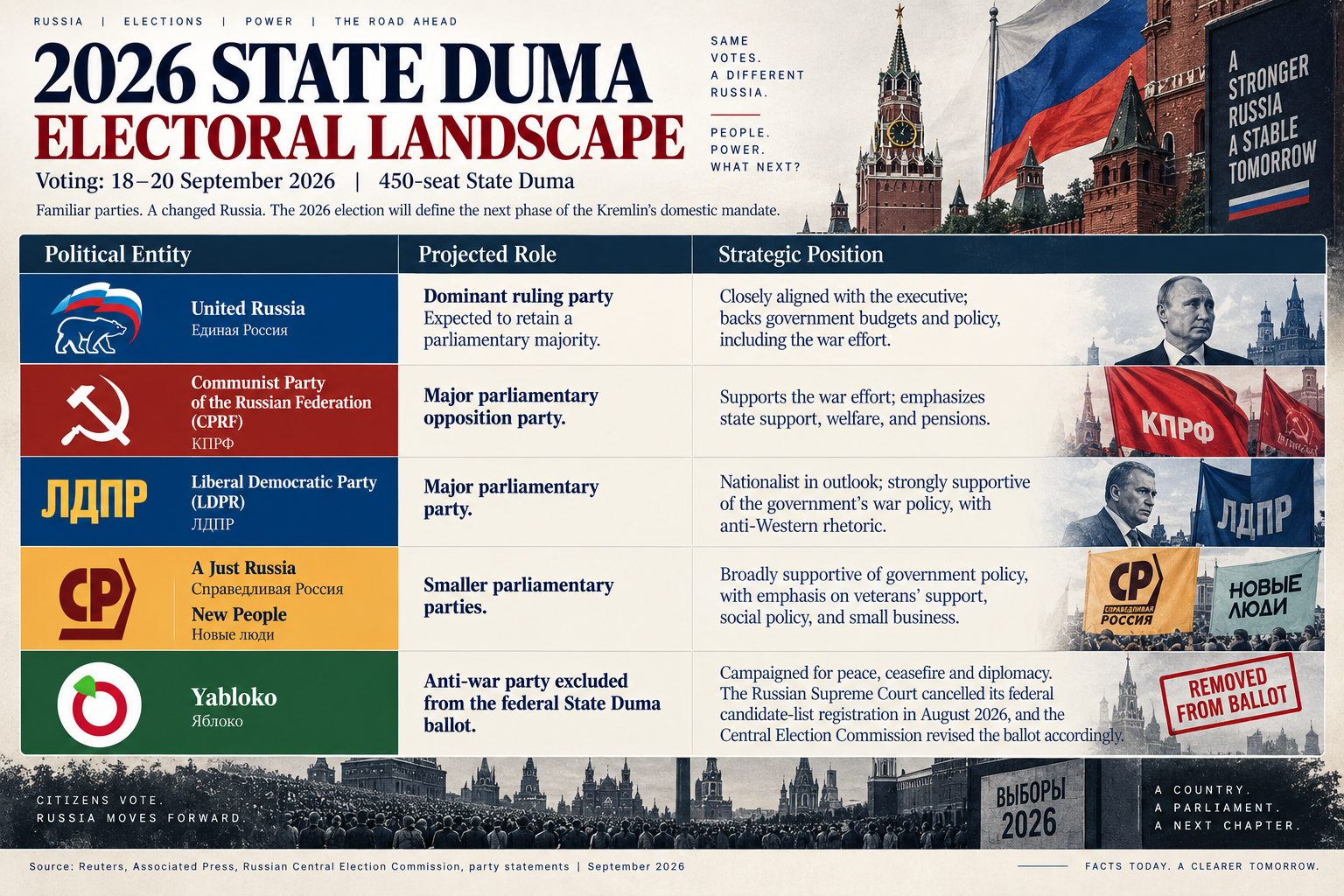
The final distribution of power is not in doubt. The ruling party, United Russia, which held 314 seats (~70%) in the outgoing assembly, is set to retain its constitutional supermajority. Independent political opposition has been systematically suppressed, while three-day voting and state-administered Electronic Digital Voting (DEG) provide extensive administrative control over the count.
However, viewing the election as an empty ritual misses its practical domestic and strategic function. For Russian citizens, the election unfolds as the war directly touches civilian infrastructure and everyday living costs. For the Kremlin, installing a compliant parliament through 2031 is a critical step in sustaining a long-term war footing.
What Are the Real Issues Facing Russian Citizens?
While state television broadcasts images of national resolve and industrial expansion, private concerns centre on the domestic fallout of the conflict:
The Physical Incursion of War: The conflict has increasingly reached the Russian interior. Throughout the summer of 2026, Ukrainian long-range drone strikes struck petroleum refineries, oil depots, and rail hubs. These attacks produced localised fuel shortages and price spikes. Repeated strikes along the Black Sea coastline and across Crimea also disrupted summer tourism, depriving millions of citizens of traditional holiday destinations.
Cost of Living and Economic Strain: Russia’s heavy military spending has raised industrial wages in defence manufacturing, but it has contributed to high inflation across food and consumer goods. Elevated central bank borrowing rates, utility tariff increases, and acute labour shortages continue to squeeze household budgets outside the defence sector.
Welfare vs. Warfare: Specialist research from the New Eurasian Strategies Centre (NEST) indicates that a growing share of Russians now question whether public healthcare, local infrastructure, and social programmes should face chronic underfunding while defence expenditure reaches post-Soviet highs.
Inter-Ethnic and Migration Tensions: Stricter government scrutiny on Central Asian migrant workers following domestic security incidents has triggered labour deficits in construction and transport, causing regional friction that candidates have largely avoided discussing.
What Are People Talking About Behind Closed Doors?
The most acute private talking point is what the government will do once the election concludes.
Rumours of a second wave of military mobilisation have circulated widely in Moscow, Saint Petersburg, and regional hubs. Citizens recall September 2022, when Vladimir Putin announced a partial mobilisation of 300,000 reservists shortly after regional votes were completed.
Despite repeated official statements that voluntary contract recruitment is meeting target quotas, anxiety has caused some young men and reservists to travel abroad temporarily to destinations like Armenia to wait out the immediate post-election window, as highlighted by The Guardian.
At the same time, public engagement with the campaigns has been muted. Campaign rallies have drawn minimal crowds, televised debates saw candidates fail to appear—leaving empty lecterns that became internet memes—and campaign advertisements have relied on generic slogans and low-cost AI graphics.
How the Kremlin Managed the Ballot
To prevent public discontent from finding an electoral outlet, authorities tightly curated the ballot:
Exclusion of Anti-War Platforms: In August 2026, election officials disqualified the liberal Yabloko party. Yabloko was the only legally recognised political force openly critical of the military campaign. When internal tracking indicated that anti-war and protest votes might consolidate behind it, the party was removed from the ballot.
The "Systemic" Buffer: The four remaining permitted parties—the Communist Party (CPRF), the Liberal Democratic Party of Russia (LDPR), A Just Russia – For Truth, and New People—act as pressure valves. They debate local municipal problems or pensions, but they vote unanimously with the Kremlin on defence budgets, foreign affairs, and security legislation.
Curating United Russia's List: United Russia chose Foreign Minister Sergei Lavrov, 76, and Moscow Mayor Sergei Sobyanin to lead its party list. Formal party leader Dmitry Medvedev was excluded from the top slot, reflecting the Kremlin's preference for Lavrov’s elder-statesman image while preventing ambitious figures from establishing independent electoral followings.
The "New Elite": Veterans on the Ballot
A core theme of Kremlin messaging has been that soldiers returning from Ukraine represent Russia’s "new elite." Under initiatives like the "Time of Heroes" program, the state encouraged veteran participation in politics.
Official figures reported by The Moscow Times show that roughly 1,600 Ukraine war veterans were registered across federal, regional, and local races, with United Russia applying an automatic 25% vote bonus to veterans during its spring primaries.
In practice, however, candidate registries show that frontline enlisted personnel rarely received viable ballot positions. Instead, most "veteran" nominees in winnable races are career regional officials or legislators who served brief tours in dedicated rear-area units to secure formal combatant credentials. The initiative serves to legitimise existing political cadres rather than bring genuine outsiders into parliament.
Probable Election Result
According to data compiled on the 2026 Russian legislative election on Wikipedia, the outcome will maintain existing political architecture:
Constitutional Dominance: United Russia will secure well over the 300 seats required to amend the constitution and approve major appointments unilaterally.
Turnout Management: Official turnout is expected to hover around 50% to 55%, heavily driven by public-sector workers, state enterprise staff, and military personnel voting through digital platforms.
Secondary Division: The CPRF and LDPR will retain their traditional positions as the second and third largest caucuses, preserving their access to state subsidies.
Impact on the Russia-Ukraine War
The 9th convocation of the State Duma will sit until 2031, spanning the 2030 presidential election. Its composition will influence the war in four concrete ways:
1. Constructing a Domestic Mandate
The Kremlin will use the election tally to present Russian society as united behind the "special military operation." This messaging is aimed externally at Western and Ukrainian leaders to project resilience, and internally to discourage domestic dissent.
2. Legislative Freedom for Unpopular Decrees
Authoritarian regimes are most sensitive to public backlash in the months leading up to a national vote. With this election passed, the executive branch has a clear domestic runway. If troop shortages necessitate renewed mobilisation, or if revenue shortfalls require tax restructuring, the new Duma will enact them without debate.
3. Institutionalising the War Economy
With approximately one-third of federal expenditure directed toward defence and security, the incoming parliament will formalise permanent legal frameworks for the war economy. This includes measures streamlining defence contracts, protecting state armaments spending, and enforcing penalties for production shortfalls.
4. Total Marginalisation of Anti-War Discourse
By eliminating any legal avenue for protest voting, the election cements the suppression of anti-war sentiment. Inside the official state apparatus, there will be no institutional debate over military strategy, territorial claims, or negotiated settlements through 2031.