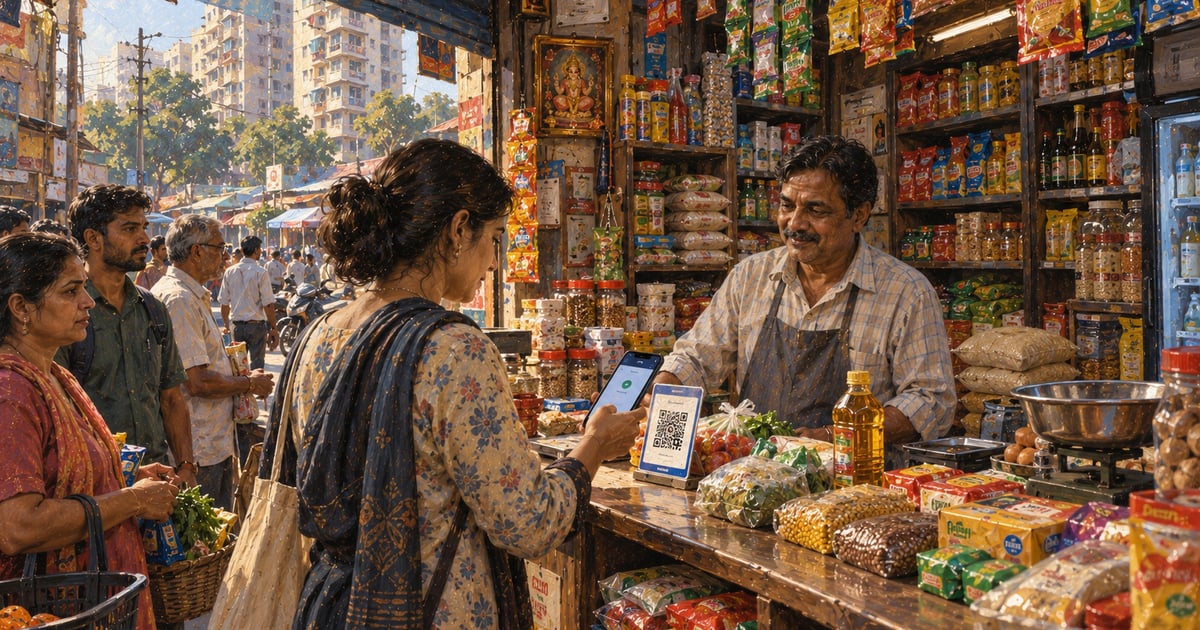
On 14 September 2026, the Central Government notified a landmark shift in India’s payment architecture, introducing a 0.4% Merchant Discount Rate (MDR) on Unified Payments Interface (UPI) merchant transactions exceeding ₹2,000 ($24), effective from 15 October 2026. The rationale presented by the Department of Financial Services and parliamentary panels sounds prudent on the surface: the payment industry estimates that operating UPI costs roughly ₹20,700 crore ($2.48 billion) per year, whereas the Union Budget allocated a comparatively modest ₹2,000 crore ($240 million) for FY27. To prevent banks from bearing uncompensated server costs, the state decided that commercial merchants must begin paying their way.
This logic is textbook microeconomics applied to a macroeconomic miracle. It mistakes an indispensable national circulatory system for a commercial retail utility.
UPI is not a private payment corridor like Visa, Mastercard, or American Express. It is foundational Digital Public Infrastructure (DPI)—the electronic equivalent of national highways, public courts, and postal roads. Suggesting that the government cannot afford to underwrite UPI because its operating costs exceed current departmental allocations ignores the immense fiscal dividend that digital payments generate for the sovereign.
In a Union Budget exceeding ₹50 lakh crore ($600 billion), the annual cost of running UPI is pocket change. More importantly, it is pocket change that buys the Indian state hundreds of thousands of crores in tax compliance, cash-displacement savings, and economic velocity.
Tapering zero-MDR is an unforced policy error. The only rational, long-term economic choice is to keep UPI free forever—and fund it entirely from the sovereign treasury.
The Sovereign Ledger: How Free UPI Pays for Itself
The argument against zero-MDR rests on a basic accounting fallacy: calculating the costs of the payment system in isolation while ignoring the massive revenue windfalls it creates across the rest of the state balance sheet.
When an economy replaces opaque physical paper with transparent digital ledgers, the government enjoys an immediate structural surge in tax collection. Every digital transaction leaves an indelible electronic audit trail. A merchant who accepts ₹5,000 via a QR code cannot easily conceal that turnover from the Goods and Services Tax (GST) network or the Income Tax Department.
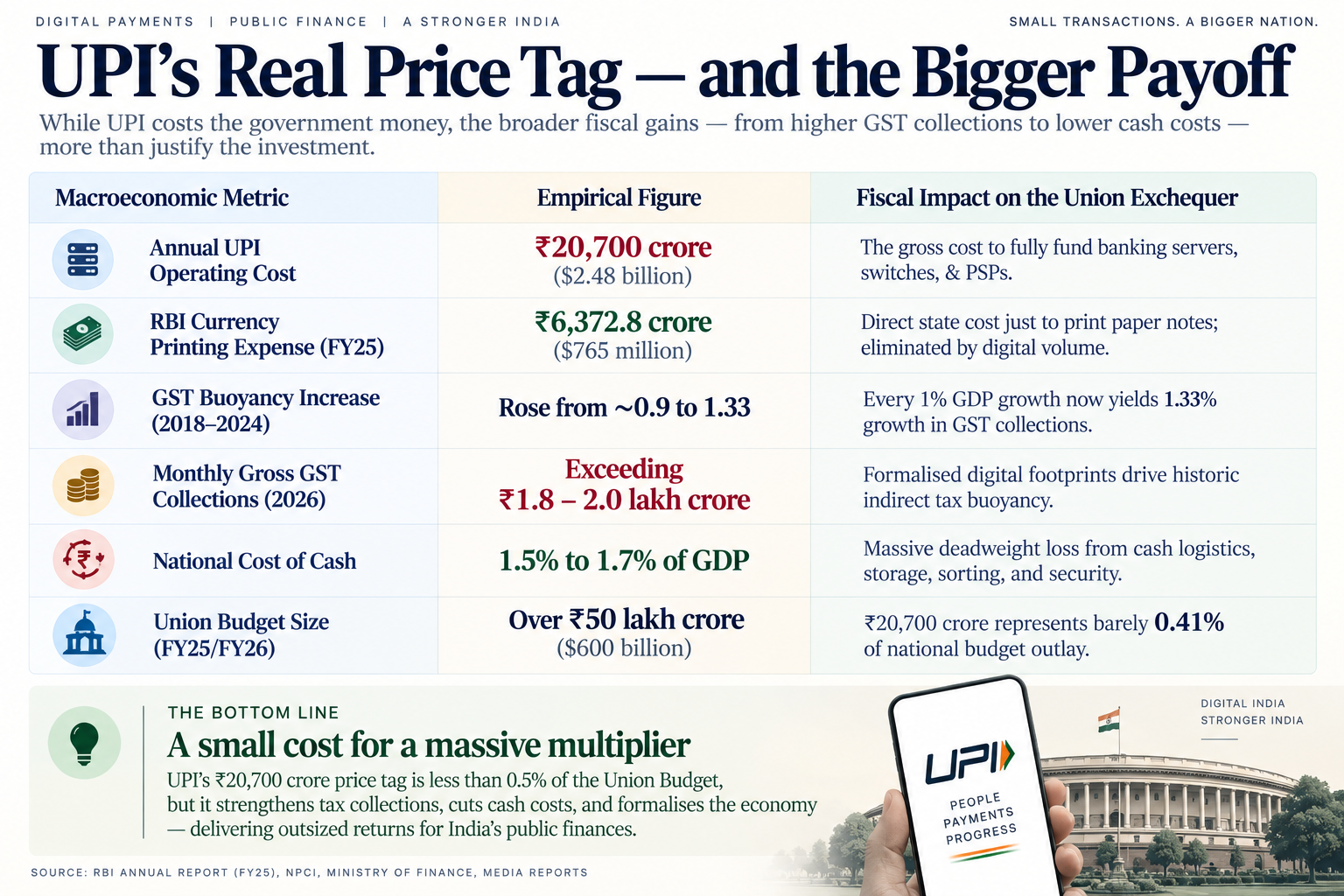
Consider the research published on Indian tax buoyancy. An empirical analysis on digital compliance and revenue buoyancy under India’s Goods and Services Tax revealed that India's GST revenue buoyancy rose from 0.9 to 1.33 following the widespread digitisation of payment trails and e-invoicing. A buoyancy figure of 1.33 means that for every 1% expansion in gross domestic product, tax revenues grow by 1.33%.
With gross monthly GST collections routinely hovering between ₹1.8 lakh crore and ₹2.1 lakh crore (yielding over ₹22 lakh crore annually), a mere 1% increase in formalised commercial turnover delivers more than ₹20,000 crore ($2.4 billion) in incremental tax receipts directly to the exchequer every year. The digital payment trail created by UPI does not cost the government money; it is one of the most prolific tax-generating engines ever built by the Indian state.
Furthermore, physical currency is extraordinarily expensive to maintain. According to the Reserve Bank of India’s Annual Report, the central bank spent ₹6,372.8 crore ($765 million) during 2024–25 exclusively on the secure printing of paper banknotes, disposing of 23.8 billion pieces of soiled currency in that year alone.
When one adds the secondary costs borne by commercial banks—operating automated teller machines (ATMs), deploying armoured security vans, paying cash-in-transit insurance, and processing cash deposit counters—studies by institutions like Tufts University estimate the macroeconomic cost of cash in India at 1.5% to 1.7% of GDP.
By processing 24.51 billion transactions in August 2026 alone, UPI displaced billions of cash handoffs. The savings in banknote printing, distribution, and cash handling dwarf the entire operational budget of the UPI switch. To spend ₹6,300 crore printing fragile paper while balking at underwriting the electronic system that replaces it is fiscal nonsense.
The Two-Sided Market Trap: Why Tiered Fees Break Trust
Advocates of the 15 September 2026 reform contend that setting the threshold at ₹2,000 protects ordinary citizens and small kirana stores. But this assumes that commerce operates along neat regulatory boundaries. In reality, two-sided payment platforms are hyper-sensitive to behavioural friction.
As fintech entrepreneur and former BharatPe co-founder Ashneer Grover pointedly observed, introducing fees on merchant transactions while leaving peer transfers uncharged creates immediate distortions: "1 lakh to a friend is free, but ₹3,000 to a merchant isn't?" Grover warned that introducing transactional friction risks turning India back towards a cash-dominated economy.
The moment a merchant is charged 0.4% on a ₹5,000 or ₹10,000 purchase, three inevitable market responses occur:
Transaction Splitting: Retailers will instruct customers to split single purchases into multiple payments under ₹2,000. A ₹4,500 clothing bill becomes three separate scans of ₹1,500. This does not eliminate the compute cost on banking servers; it triples it, multiplying network calls while generating zero revenue.
Off-Ledger P2P Arbitrage: Small business owners will replace their commercial merchant QR codes with personal savings account QR codes. Transactions that should be classified as commercial commerce will masquerade as personal P2P gifts, blinding tax authorities and distorting banking data.
The Return of the Cash Discount: Retailers operating on thin operating margins—such as electronics dealers, wholesale distributors, and hardware merchants—will offer outright cash discounts to avoid the fee and the accompanying tax visibility.
Zero-MDR succeeded not because it was cheap, but because it was absolute. It eliminated calculation at the point of sale. A checkout process with conditions, thresholds, and category exclusions destroys the psychological simplicity that drove 55.49 crore Indians to abandon cash in the first place.
In a ₹50 Lakh Crore Budget, ₹20,700 Crore Is an Investment, Not an Expense
The core fiscal argument must be stated plainly: India’s Union Budget can easily afford to pay for UPI.
For FY26/27, total government expenditure exceeds ₹50 lakh crore ($600 billion). The state routinely allocates massive outlays to subsidise critical sectors of the economy:
Over ₹2,00,000 crore ($24 billion) annually on food security and public distribution.
Over ₹1,60,000 crore ($19.2 billion) on fertiliser subsidies to protect agricultural yields.
Over ₹11,00,000 crore ($132 billion) on capital expenditure for physical roads, bridges, and railways.
Why does the state spend hundreds of thousands of crores building six-lane national expressways without expecting toll gates to cover every rupee of construction and maintenance on day one? Because highways are an economic force multiplier. They lower freight logistics costs, connect isolated producers to urban markets, and stimulate national GDP.
UPI is the electronic expressway of the Indian economy. It facilitates economic velocity for nearly half the nation's retail GDP. To allocate ₹11 lakh crore to physical asphalt while refusing to spend ₹20,700 crore—barely 0.41% of the Union Budget—to fully underwrite the digital bloodstream of the entire country represents a profound misallocation of public capital.
Instead of starving the banking ecosystem and forcing banks to absorb uncompensated server loads or levy MDR on merchants, the government should simply do what a sovereign government is designed to do: fully fund the ₹20,700 crore operating requirement directly from the Union Budget.
If the state directly compensates remitter banks, beneficiary banks, and NPCI with an assured, volume-indexed budgetary transfer of ₹20,000 crore annually:
Commercial banks would be fully reimbursed for server upgrades, cybersecurity protocols, and hardware security modules, eliminating technical transaction failures.
The entire network would remain 100% free for all merchants, from the roadside coconut vendor to the largest department store.
The domestic fintech sector could innovate without relying on predatory unsecured consumer lending or surveillance-driven cross-selling to survive.
The formalisation of Indian retail would continue unhindered, generating far more than ₹20,000 crore in annual GST and direct corporate income taxes.
The True Meaning of a Digital Public Good
A public good is defined by non-excludability and non-rivalry. When the Indian government championed the India Stack across the world, it rightly pitched UPI as a shining beacon of Digital Public Infrastructure—proof that a developing democracy could provide high-technology public rails without surrendering payment sovereignty to predatory foreign card schemes or private monopolies.
By introducing MDR, even in a calibrated form, India compromises that foundational doctrine. It concedes to the flawed worldview that digital rails must extract tolls from daily commerce to justify their existence.
UPI does not need to extract tolls from merchants. It has already paid for itself many times over in the form of wider tax nets, lower currency management expenses, enhanced monetary velocity, and unprecedented financial inclusion for hundreds of millions of unbanked citizens.
The Government of India should scrap the October 2026 MDR framework, expand its budgetary support from ₹2,000 crore to the full ₹20,700 crore required by the ecosystem, and declare that the Unified Payments Interface will remain completely, unconditionally, and permanently free.