In brief
- Nvidia chief executive Jensen Huang acknowledged an affair in a memo, triggering an independent inquiry overseen by independent directors and outside legal counsel as the company faces a corporate and geopolitical crisis.
- The affair involved Alice Huang, also known as Huang Le, who US intelligence agencies believe was recruited by Beijing’s Ministry of State Security, raising national security concerns for Nvidia.
- Investigations revealed that Megaspeed subsidiaries ordered at least $4.8 billion worth of Nvidia hardware between mid-2024 and early 2026, importing an estimated 136,000 GPUs and leasing compute capacity to Chinese tech firms.
- The events have prompted congressional summons and federal scrutiny over semiconductor smuggling and executive security protocols within Silicon Valley, as Nvidia sits at the centre of the AI technology boom.
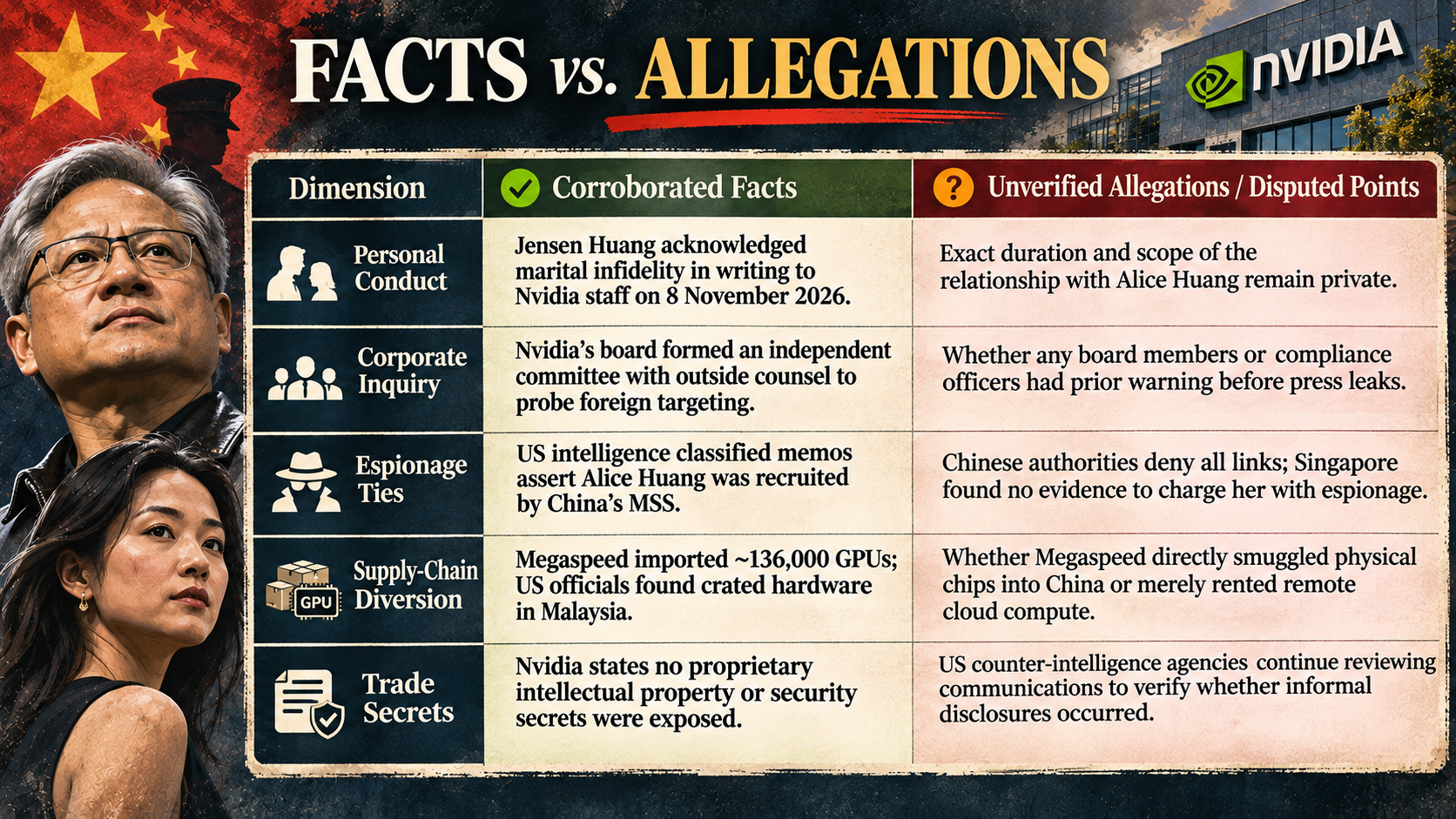
On Sunday, 8 November 2026, Nvidia co-founder and Chief Executive Jensen Huang sent a candid memo to the chipmaker’s global workforce. "I was unfaithful to my wife," Huang wrote. "My actions hurt her and our children. There is no excuse for what I did. I am deeply sorry." He added that he accepted full responsibility and welcomed criticism.
Within hours, Nvidia’s board of directors confirmed it had initiated an independent inquiry overseen by independent directors and outside legal counsel. The catalyst was not marital misconduct in isolation, but the identity of the woman involved: Alice Huang, also known as Huang Le, a Chinese businesswoman whom US intelligence agencies believe was recruited by Beijing’s principal civilian espionage service, the Ministry of State Security (MSS).
The disclosure has transformed what would otherwise be a private family crisis into an unprecedented corporate and geopolitical emergency. Nvidia sits at the technological epicentre of the artificial intelligence boom, manufacturing the graphic processing units (GPUs) that power foundational AI models, military simulation systems, and national computing clusters. The revelation that its chief executive had an intimate relationship with an alleged foreign intelligence asset has ignited congressional summons, federal scrutiny over semiconductor smuggling, and difficult questions regarding executive security protocols in Silicon Valley.
The Paper Trail: From a Malaysian Warehouse to Intelligence Unmasking
The crisis did not begin in Nvidia’s Santa Clara headquarters, but in Southeast Asia’s rapidly expanding data-centre corridor.
According to reporting by The New York Times, the US Department of Commerce initiated an inquiry in late 2024 after trade enforcement officials visited a data centre in Malaysia operated by Megaspeed International, a Singapore-registered entity. Officials discovered high-end Nvidia server equipment sitting unopened in original packaging. Rather than being wired into local commercial server racks, the hardware appeared to be staged for onward transit—a classic signature of sanctions evasion designed to bypass US Department of Commerce Bureau of Industry and Security (BIS) export curbs on advanced AI semiconductors to mainland China.
Subsequent investigations revealed that Megaspeed subsidiaries had ordered at least $4.8 billion (approximately ₹40,000 crore) worth of advanced Nvidia hardware between mid-2024 and early 2026, importing an estimated 136,000 GPUs. Megaspeed leased compute capacity to Chinese tech giants, including Alibaba, providing cloud-based access to computational power that Washington had explicitly attempted to sever.
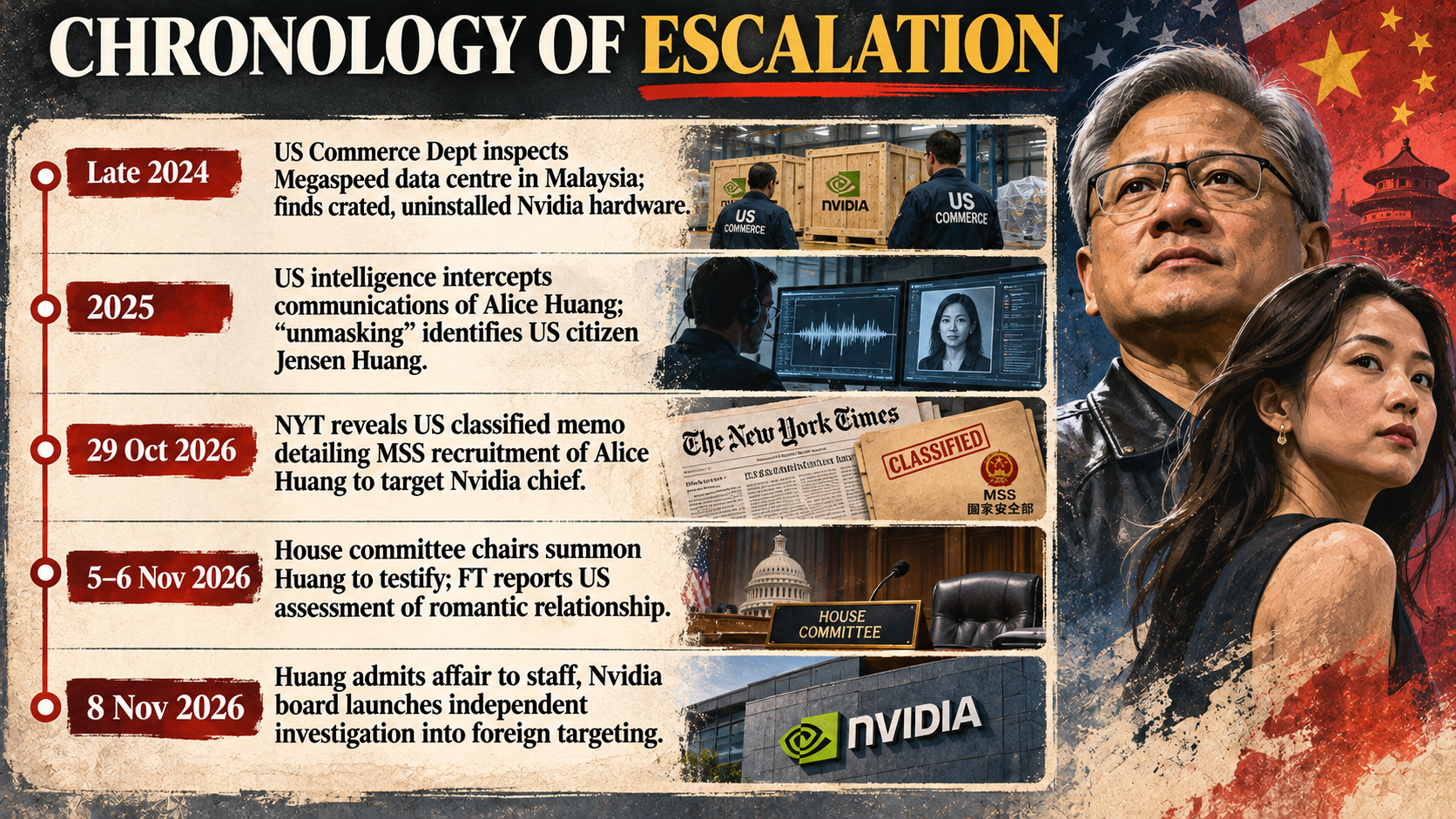
During electronic surveillance of Alice Huang—then an executive and significant shareholder in Megaspeed—US intelligence agencies picked up intercepts between her and an unnamed American citizen. Under established US surveillance protocol, domestic citizens intercepted during foreign intelligence gathering have their names masked in internal reports. When senior intelligence analysts submitted an official "unmasking" request, the American was revealed to be Jensen Huang.
Who Is Alice Huang?
Public records paint a picture of an agile operator who transitioned across state media, finance, and cross-border tech brokerage:
Early Career: A Chinese citizen with no biological relation to Jensen Huang, she worked as a television reporter in mainland China before moving into corporate finance and banking, including a stint at HSBC.
Corporate Pivot: By March 2023, she had taken over the Singapore entity that became Megaspeed International, acting as managing director. Corporate ownership moved through an offshore vehicle, Huang Le Limited, before being transferred to Swiftdata in late 2023, where she subsequently stepped down as director while remaining the public face of the enterprise.
Tech Networking: At the Computex technology trade fair in Taipei in June 2024, she was introduced in industry circles as the head of Megaspeed. It was around this period that industry photographs captured her in close proximity to Jensen Huang, coinciding with Megaspeed’s multibillion-dollar purchase commitments for Nvidia hardware.
MSS Recruitment Allegations: A classified intelligence assessment circulated among senior Washington officials in 2025 stated that China’s Ministry of State Security recruited her specifically to cultivate Silicon Valley executives, collect competitive intelligence on Nvidia’s next-generation architectures, and assess Washington’s evolving export restrictions.
Espionage Operation or Customer Relationship?
Nvidia and its chief executive have sought to draw a strict line between personal indiscretion and commercial compromise.
In public remarks and corporate filings, Nvidia has insisted that its transactions with Megaspeed complied with existing regulations and represented standard business activities. A corporate spokesperson stressed that "meetings with customers are part of a CEO’s job; Jensen talks with thousands of customer executives every year." The company maintains that Megaspeed received ordinary commercial specifications and pricing information—not classified design schematics, wafer yields, or national security-grade data.
Furthermore, Nvidia’s internal compliance audits reportedly found no direct evidence that the company knowingly abetted chip smuggling. The board’s statement emphasized that it has "no reason to believe that either national security or NVIDIA secrets were compromised."
Yet counter-intelligence specialists note that the primary value of an asset in Alice Huang’s position would not necessarily be the physical theft of blueprint files. In human intelligence (HUMINT) tradecraft, direct access to a chief executive yields invaluable strategic intelligence:
Regulatory Sentiment: Insight into how aggressively Nvidia intends to lobby the White House on export limits.
Product Roadmaps: Early indications of delivery timelines for modified, lower-compute chips intended for the Chinese market.
Political Dynamics: Real-time visibility into Huang’s high-level interactions with political leadership, including his advisory relationships with Donald Trump’s administration.
Washington Reacts: Subpoenas and Political Repercussions
The scandal has arrived at a precarious political moment. Donald Trump, who has cultivated warm ties with Huang and celebrated Nvidia’s domestic manufacturing commitments, offered an initial defense on Sunday evening, calling Huang an "honorable guy" while conceding, "you never know what is going on... I think he probably has an excuse for it. You have to hear it."
Capitol Hill, however, is not content to wait for the conclusion of Nvidia’s board review. The Republican chairmen of three powerful House panels—John Moolenaar of the Select Committee on the Chinese Communist Party, Brian Mast of the Foreign Affairs Committee, and Rick Crawford of the Intelligence Committee—have jointly requested a closed-door briefing from Huang scheduled for 18 November 2026.
Lawmakers are demanding comprehensive logs of all communications between Nvidia executives and Megaspeed representatives, an accounting of how Megaspeed passed "know-your-customer" (KYC) screening, and details of Nvidia’s internal protocols for shielding senior personnel from foreign intelligence recruitment. Democrats have echoed calls for broader hearings, with incoming Senate leaders indicating that the Commerce Department’s export-licensing apparatus will face tough questioning.
The Broader Lesson for the Tech Sector
The crisis surrounding Jensen Huang represents a structural inflection point for the global semiconductor industry. For decades, Silicon Valley executives operated as borderless commercial visionaries, travelling freely between Taipei, Beijing, Tokyo, and San Francisco.
The US-China tech rivalry has dismantled that operating model. Advanced computing silicon is now classified alongside nuclear centrifuges and stealth avionics as foundational national security technology. When an industry becomes the primary front in a cold war, its corporate leaders become high-value intelligence targets.
Whether the Nvidia board’s investigation uncovers specific leaks or clears Huang of any operational breach, the damage to the executive’s aura of untouchability is real. As the global AI race accelerates, Silicon Valley boardrooms must confront an uncomfortable reality: geopolitical risk is no longer just a regulatory line item in an annual report; it is an active counter-intelligence battlefield reaching into the private lives of tech’s most powerful figures.