In brief
- Nvidia CEO Jensen Huang resigned on 12 November 2026 after 33 years, following a 96-hour crisis triggered by a New York Times report alleging a second extramarital relationship with a direct subordinate, VP Healthcare Kimberly Powell.
- The board appointed CFO Colette Kress as Interim CEO and named Harvey C. Jones as first Chair, while independent directors retained former prosecutor Joon H. Kim and Wachtell Lipton to investigate.
- Shares fell 10.4% premarket; valuation dropped from $5.76 trillion on 6 October to $4.18 trillion on 12 November, erasing $1.58 trillion over 26 sessions amid the scandal and hotter US inflation data.
- Three US House committees still plan to question Huang on 18 November over Megaspeed's $4.8 billion GPU orders and alleged Chinese intelligence links, while Wachtell Lipton's investigation continues ahead of 17 November earnings.
On Thursday, 12 November 2026, Nvidia Corporation announced that its co-founder, President, and Chief Executive Officer, Jensen Huang, had resigned effective immediately, also relinquishing his seat on the board of directors. Executive Vice President and Chief Financial Officer Colette Kress has stepped in as Interim CEO while retaining her finance remit, and long-time director Harvey C. Jones has been named Nvidia’s first-ever Chair of the Board.
The departure ends a 33-year tenure during which Huang transformed a graphics-card startup founded in 1993 into the primary hardware engine of the global artificial intelligence boom. It also brings an abrupt end to a four-day boardroom crisis triggered not by a single scandal, but by the compounding collision of national security scrutiny and internal corporate governance rules.
On Sunday, 8 November, Nvidia’s board had publicly expressed "confidence in Jensen" even after he admitted to an extramarital affair linked to a US counter-intelligence investigation. What shattered that support within 96 hours was a fresh revelation late on Wednesday, 11 November: a New York Times report alleging that Huang had engaged in a separate extramarital relationship with a senior Nvidia executive who reported directly to him.
The 96-Hour Timeline: From Confession to Resignation
The speed of Huang’s exit reflects how rapidly a founder’s political capital can evaporate once independent directors retain outside investigators and internal compliance thresholds are breached.
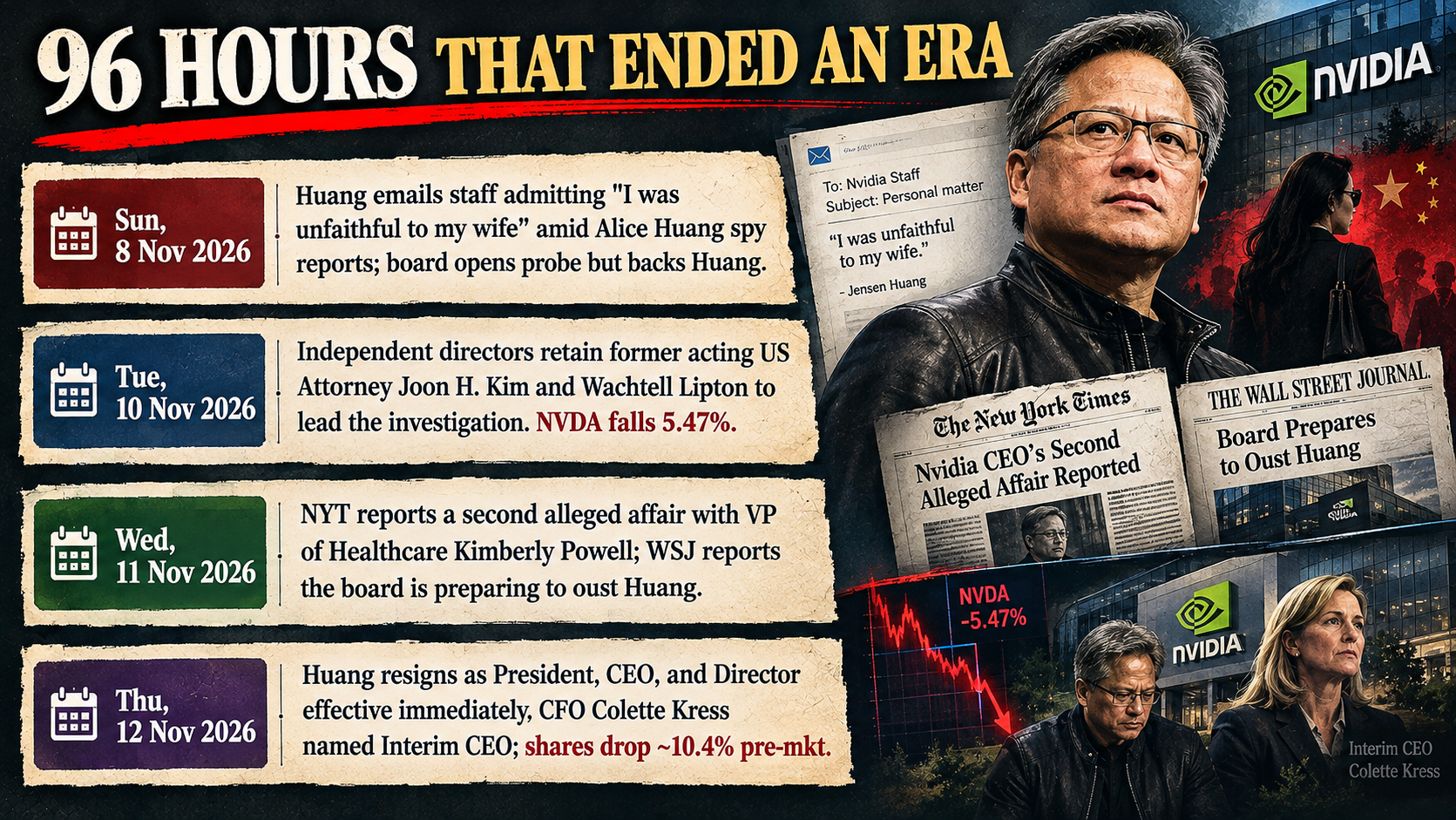
The sequence began to accelerate on Tuesday, 10 November, when the independent members of Nvidia’s board announced they had retained Joon H. Kim—a former acting US Attorney for the Southern District of New York—and his law firm, Wachtell, Lipton, Rosen & Katz, to conduct "a thorough and independent investigation". Appointing a heavyweight Wall Street litigation and white-collar defence team signalled that the board’s review had moved well beyond a routine internal check.
Barely 24 hours later, The New York Times published details of a second alleged relationship involving Kimberly Powell, Nvidia’s 48-year-old Vice President of Healthcare. Within hours, The Wall Street Journal reported that the board was preparing to convene to remove Huang. By Thursday morning, before US markets opened, Huang had tendered his resignation.
The Second Scandal: Who Is Kimberly Powell and Why Did It Change Everything?
Kimberly Powell is not a peripheral figure at Nvidia. An engineer who joined the chipmaker in 2008, she spent nearly two decades building Nvidia’s medical imaging, genomics, and AI drug-discovery business, overseeing flagship platforms such as Clara and BioNeMo. Appointed Vice President of Healthcare in 2017, Powell reported directly to Jensen Huang.
Citing five people who had worked at Nvidia, The New York Times reported on 11 November that Huang and Powell had engaged in an extramarital relationship, with accounts alleging the two were seen behaving affectionately at a San Jose hotel during Nvidia’s GTC developer conference in March 2026. Neither Huang nor Powell has publicly confirmed or commented on the allegation, and Nvidia declined to comment to the newspaper. Shortly after the report surfaced, Powell withdrew from a scheduled opening-panel appearance at the Milken Institute’s Future of Health Summit.
To understand why this unconfirmed report proved fatal to Huang’s leadership when an alleged Chinese espionage scandal did not, it is necessary to separate external geopolitical risk from internal corporate governance law.
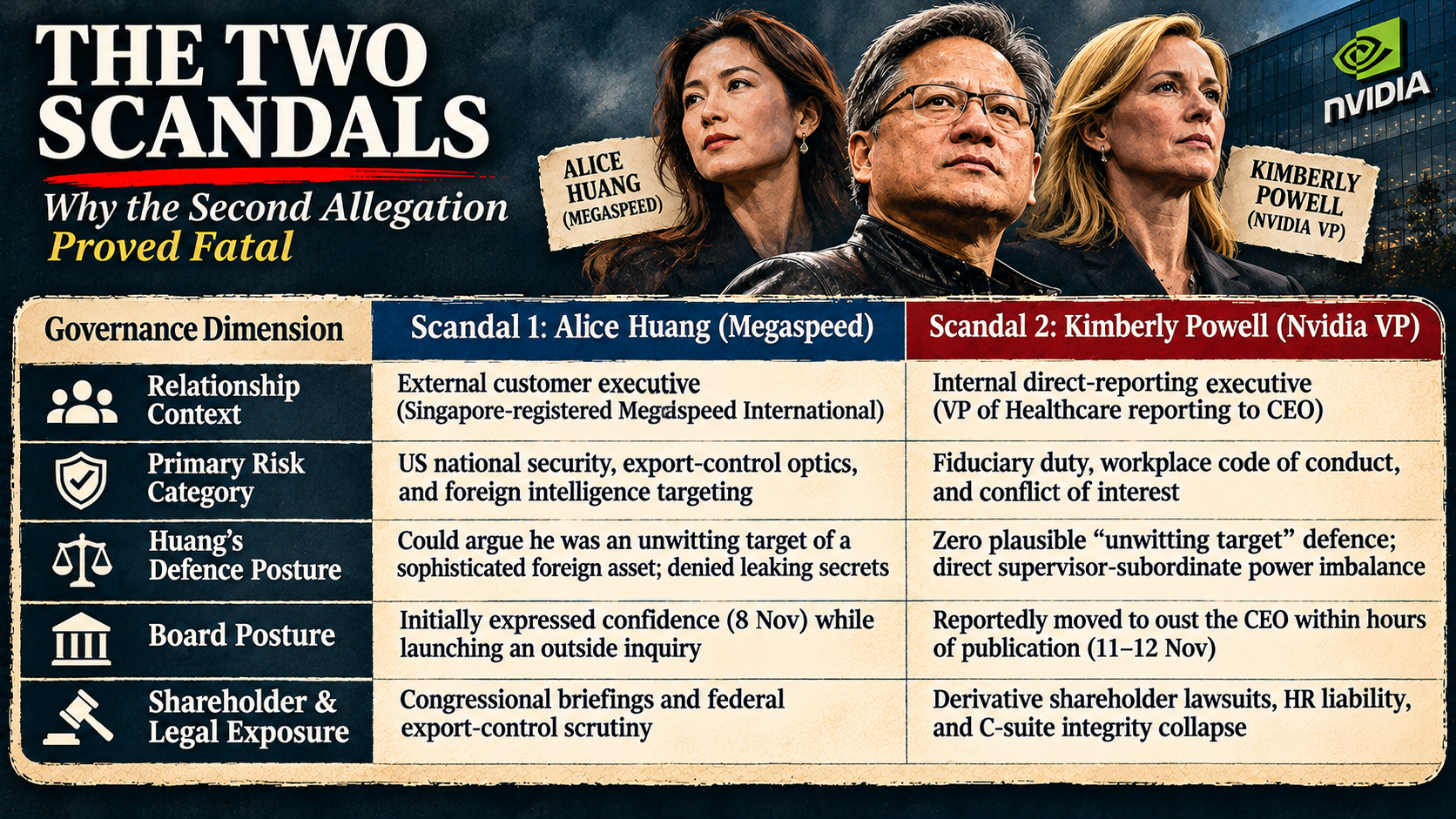
In modern US corporate governance, boards routinely forgive—or at least ring-fence—a founder’s personal indiscretions if they can be framed as private matters or external entrapment. An alleged relationship with a direct subordinate, however, strikes directly at a board’s fiduciary obligations. It creates immediate exposure regarding promotion fairness, compensation oversight, workplace culture, and compliance with corporate codes of ethics—precisely the kind of conduct that has ended the tenures of other high-profile executives, from Intel’s Brian Krzanich in 2018 to McDonald’s Steve Easterbrook in 2019.
The Transition: Colette Kress, Harvey Jones, and an Unprecedented Board Shake-Up
Nvidia’s Thursday announcement was carefully structured to reassure institutional investors that the company’s operational machinery remains intact.
Interim Chief Executive: Colette Kress, who joined Nvidia as CFO in September 2013 after nearly 25 years in finance roles at Microsoft and Cisco, is widely known to Wall Street. Alongside Huang, she has co-hosted Nvidia’s quarterly earnings calls during an expansion that lifted annual revenue from $4.13 billion in FY14 to $215.9 billion in FY26. Retaining her as both CFO and Interim CEO signals continuity ahead of Nvidia’s third-quarter FY27 financial results on Tuesday, 17 November.
First-Ever Board Chair: The appointment of Harvey C. Jones—a venture investor and former CEO and Executive Chairman of chip-design software leader Synopsys—as Nvidia’s first formal Chair of the Board marks a decisive break from founder-centric governance. By separating board leadership from the executive suite, independent directors are institutionalising tighter oversight over whoever is chosen as permanent chief executive.
That search will consider both internal and external candidates. Yet replacing Huang is uniquely daunting. Unlike conglomerates with deep benches of divisional chiefs, Nvidia has operated with a notoriously flat hierarchy in which dozens of senior vice presidents reported directly to Huang, who personally steered product roadmaps, developer relations, and diplomatic lobbying in Washington and Taipei.
Market Shock and Strategic Fallout
Investors reacted sharply to the sudden loss of Nvidia’s chief strategist. Shares fell roughly 10.4% in premarket trading on Thursday morning, extending a steep multi-week slide.
Between its record peak market capitalisation of $5.76 trillion on 6 October 2026 and 12 November, Nvidia’s valuation had contracted to approximately $4.18 trillion—erasing roughly $1.58 trillion (over ₹1,33,00,000 crore, or ₹1.33 crore crore) across 26 trading sessions. While the CEO scandal and governance turmoil were the immediate catalysts this week—wiping out hundreds of billions of dollars since Sunday—the sell-off has also been compounded by hotter-than-expected US consumer price inflation (CPI) data and growing market debate over the pace of hyperscaler AI infrastructure spending.
Beyond Wall Street, Huang’s resignation does not resolve the geopolitical storm that sparked the crisis. The chairs of three US House committees—the Select Committee on the Chinese Communist Party, Foreign Affairs, and Intelligence—had already summoned Huang for a closed-door briefing on 18 November regarding Megaspeed’s ~$4.8 billion (₹40,000 crore) in GPU orders and Alice Huang’s alleged links to China’s MSS. Meanwhile, Wachtell Lipton’s independent investigation remains active, leaving Nvidia’s new interim leadership to navigate regulatory inquiries, a high-stakes earnings call next week, and the most consequential CEO search in the history of the semiconductor industry.