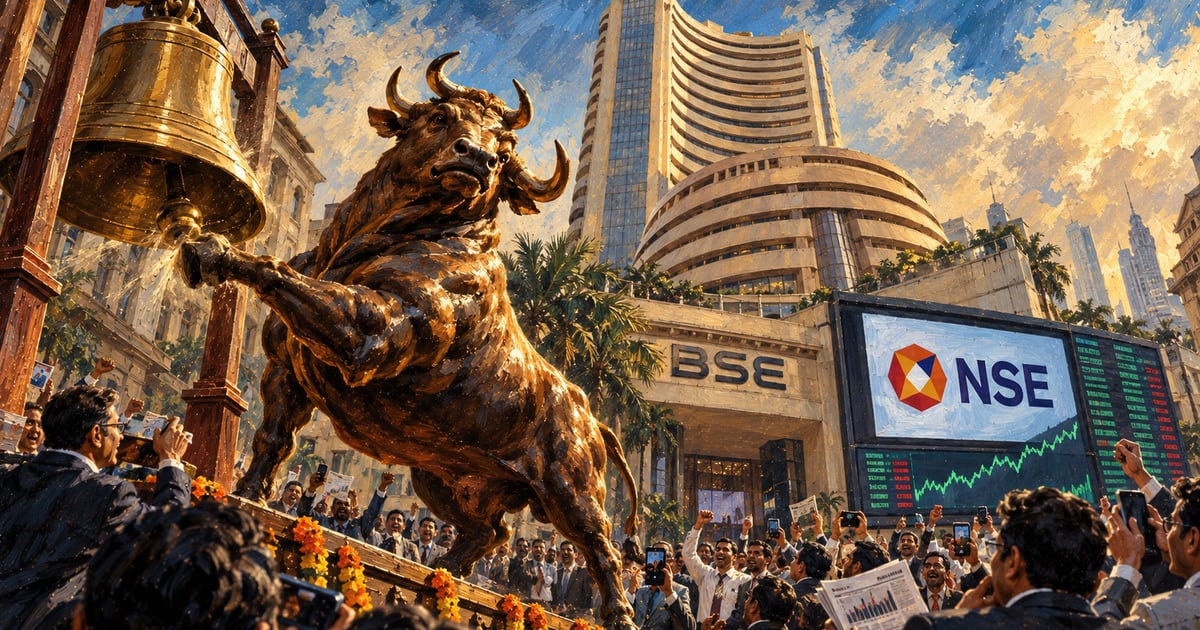
On 24 September 2026, the trading terminals at Phiroze Jeejeebhoy Towers in downtown Mumbai flashed a ticker that had spent nearly a decade in regulatory purgatory: the National Stock Exchange of India Limited.
In a market defined by intense commercial rivalry, the arrangement was striking. India's dominant stock exchange—an electronic venue handling over 90% of the country’s cash equity turnover and the vast majority of its equity derivatives—was officially open for trading, exclusively on the order books of its historic rival, the Bombay Stock Exchange (BSE).
The listing brought an end to one of the longest-running corporate journeys in modern Indian finance. Structured as a ₹22,569 crore ($2.45 billion) pure Offer for Sale (OFS), the issue surpassed the ₹21,008 crore raised by Life Insurance Corporation of India in May 2022 to become India’s largest-ever initial public offering.
When trading commenced, market response was measured rather than euphoric. Shares of NSE opened at ₹1,800 on the BSE—a 0.84% premium over the issue price of ₹1,785—before touching an intraday high of ₹1,839 and closing at ₹1,818, an initial-day gain of 1.85%, as reported by Fortune India and HDFC Sky. At the close, NSE was valued at approximately ₹4.42 lakh crore ($46 billion), placing it among the five most valuable exchange groups globally.
Why NSE Cannot Trade on NSE: The Rule of Cross-Listing
To observers outside Indian market governance, an exchange listing on its direct competitor seems counter-intuitive. However, the legal framework governing Market Infrastructure Institutions (MIIs) mandates this separation.
Under Regulation 41(3) of the Securities and Exchange Board of India (Stock Exchanges and Clearing Corporations) Regulations, 2018 (SECC Regulations), a recognized stock exchange is explicitly barred from listing its own securities on its own platform.
This structural firewall is designed to prevent frontline regulatory conflicts of interest. In India’s two-tier oversight model, a stock exchange acts as a frontline regulator. It conducts real-time market surveillance, enforces disclosure rules under the Listing Obligations and Disclosure Requirements (LODR), monitors insider trading, and orders trading halts.
If an exchange traded its own shares on its own platform:
It would face an immediate conflict of interest when handling abnormal volatility or suspected manipulation in its own stock.
Its management would retain discretionary control over trading halts and circuit filters affecting its equity value.
Internal compliance investigations could clash with commercial pressures.
When BSE carried out its public listing in February 2017, it adhered to this rule by listing its shares on the NSE. With NSE now listed on BSE, the cross-listing symmetry between India's two principal exchanges is complete, as examined in Stockify's Regulatory Analysis.
The Ten-Year Journey (2016–2026)
NSE's road to Dalal Street was delayed by years of regulatory and legal scrutiny:
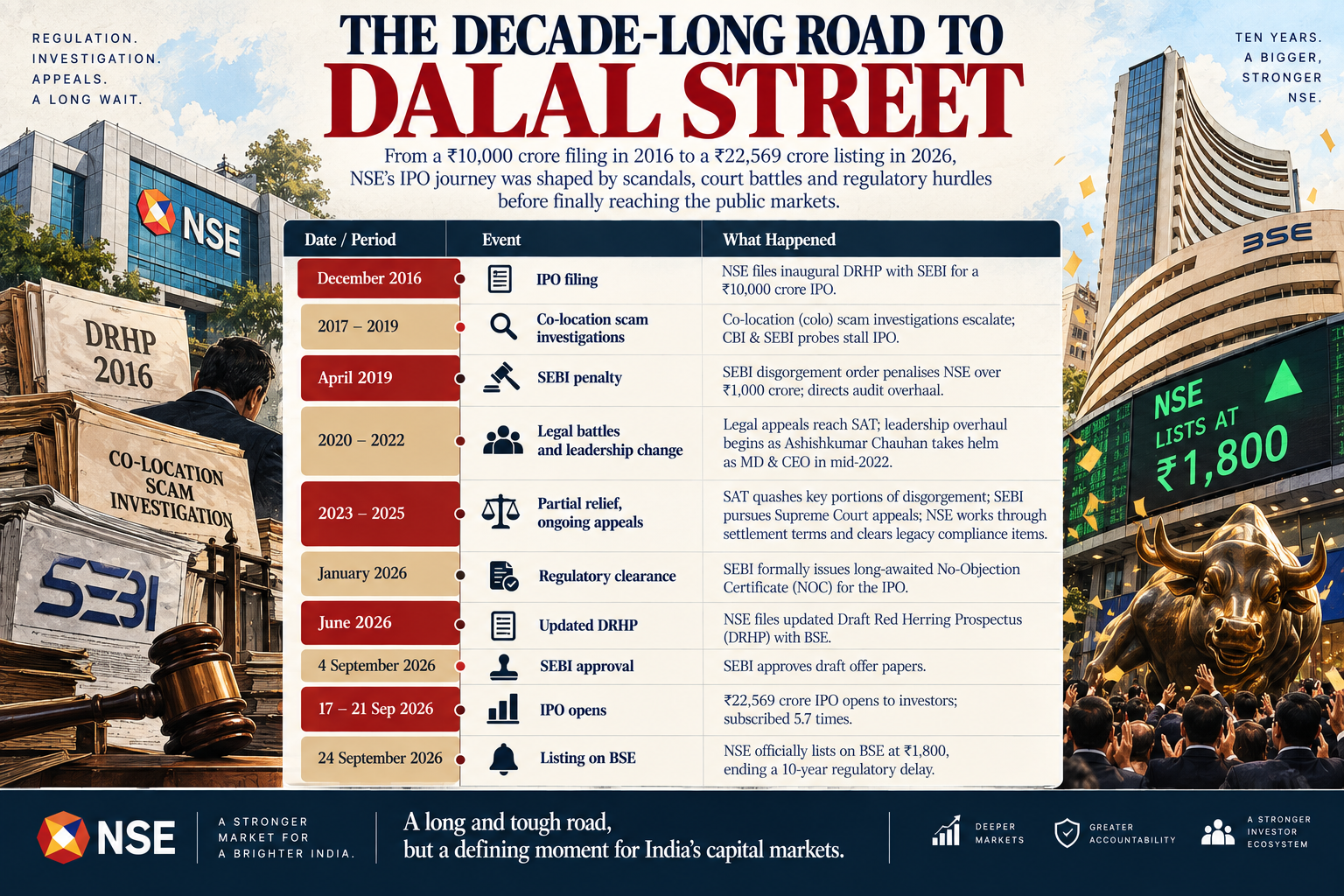
The delay originated in late 2016. Shortly after submitting its initial prospectus, the exchange faced whistle-blower allegations involving its co-location server setup between 2010 and 2014. The claims highlighted preferential access granted to certain algorithmic high-frequency trading brokers via secondary tick-by-tick servers and point-to-point dark-fibre links.
The resulting actions included:
Regulatory Sanctions: SEBI halted the listing, ordered the disgorgement of over ₹1,000 crore in revenues, and opened probes into former executives, as detailed in NDTV Profit's Timeline.
Litigation: The Securities Appellate Tribunal (SAT) set aside key sections of SEBI’s disgorgement orders while upholding findings of governance failures, after which proceedings moved to the Supreme Court.
Institutional Transition: Under MD & CEO Ashishkumar Chauhan (who took charge in 2022), the exchange resolved outstanding regulatory notices, upgraded technology and surveillance infrastructure, and rebuilt working relationships with market authorities.
The formal clearance came in January 2026 when SEBI granted its No-Objection Certificate (NOC), leading to an updated Draft Red Herring Prospectus in June and approval in early September.
Issue Structure: A 100% Secondary Offering
At ₹22,569 crore ($2.45 billion), the IPO is the largest in Indian market history, with specific structural characteristics:
Zero Primary Proceeds: The float was structured entirely as an Offer for Sale (OFS) of 12,64,36,800 equity shares. NSE did not receive any capital from the transaction.
Organic Cash Flow: NSE generates net profit margins in excess of 60% and maintains substantial internal reserves, eliminating the need for primary equity dilution to fund capital expenditures.
Secondary Liquidity: The issue served as a structured exit window for institutions that had held stakes for years, including State Bank of India, Bank of Baroda, CPPIB, Aranda Investments, and public-sector insurance companies, as outlined in Groww's Issue Review.
An anchor allocation of ₹6,746.2 crore was secured ahead of the public window from institutional investors such as the Abu Dhabi Investment Authority (ADIA), Norges Bank, Fidelity, and LIC, according to Stockify's Financial Research.
Comparative Operating Metrics: NSE vs BSE
Evaluating the ₹4.42 lakh crore ($46 billion) valuation requires comparing the scale and financial profile of the two exchanges:
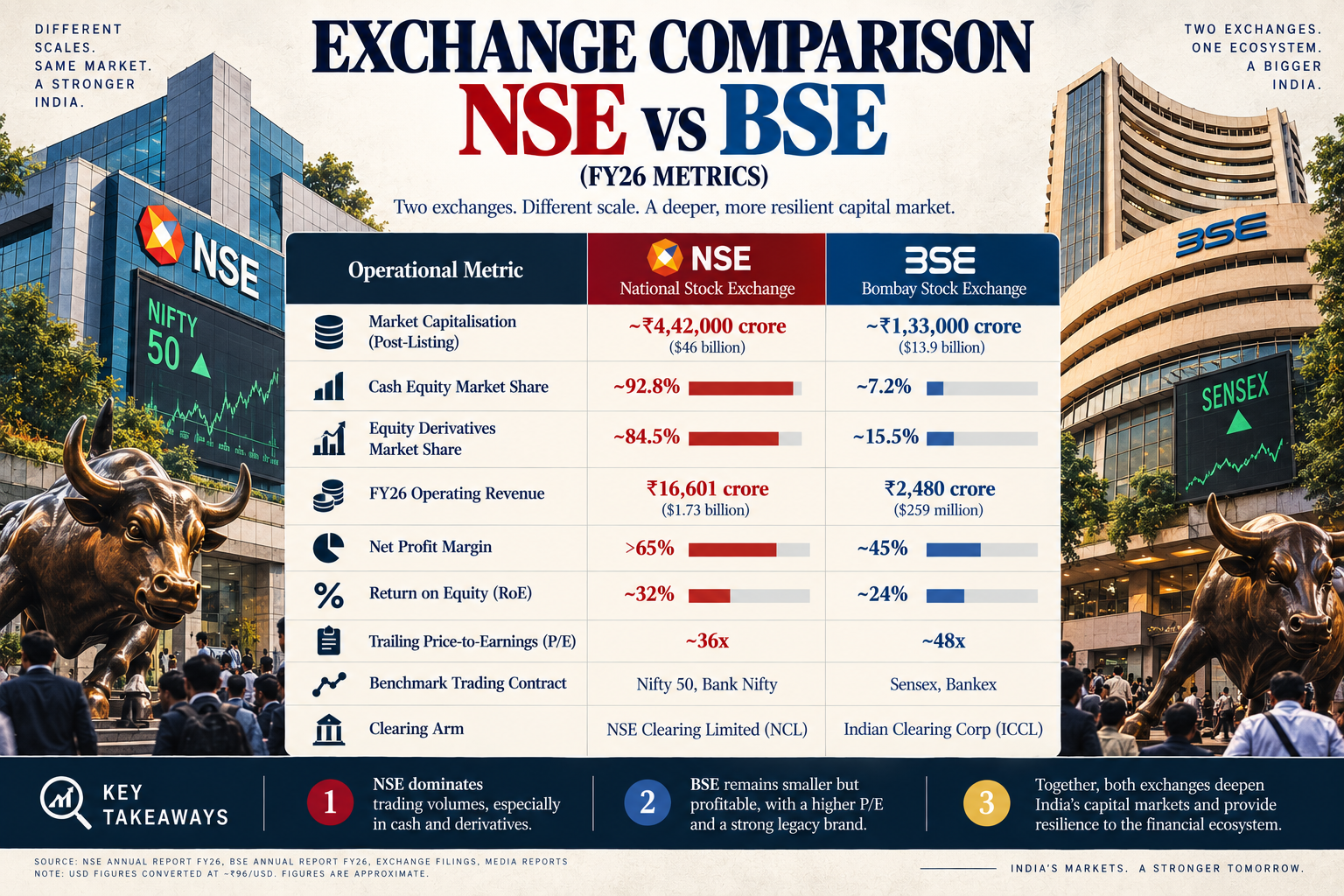
Liquidity Depth: NSE retains clear market leadership in cash equity trading, holding roughly 93% market share.
Derivatives Competition: Under MD & CEO Sundararaman Ramamurthy, BSE revitalised its Sensex and Bankex contracts, growing its equity derivatives market share from less than 2% in early 2023 to more than 15% in 2026.
Valuation Rebalancing: NSE came to market at roughly 36 times trailing earnings, a discount to BSE’s ~48x multiple. This contributed to a 3% drop in BSE shares on 24 September as institutional portfolios reallocated capital to NSE, as documented by Fortune India.
Factors Influencing the Moderate Opening
The 1.85% first-day gain reflected several regulatory and market dynamics:
1. SEBI Measures on Retail Derivatives
Following SEBI studies showing that over 90% of active retail traders lost money in futures and options, the regulator implemented measures to curb speculative volumes:
Contract Expiries: Restricting exchanges to one weekly index expiry per platform.
Contract Size: Raising the minimum index derivative contract value from ₹5 lakh to ₹15 lakh–₹20 lakh.
Margin Requirements: Removing calendar spread discounts on expiry days and requiring upfront margin collection.
Industry research from Smartkarma shows that options contract volumes declined 51.5% across the market in FY26, resulting in a 3.1% decline in NSE’s operating revenue to ₹16,601 crore.
2. Clearing Fee Compression
Under SEBI’s interoperability rules, trades on one exchange can clear through any approved clearing house. NSE Clearing Limited (NCL) saw its cash settlement share moderate from 94.24% to 88.42% and derivatives clearing share ease from 95.67% to 91.04% in FY26, creating fee pressure.
3. Pre-IPO Unlisted Trading
Because NSE shares had traded in the unlisted market for several years between ₹1,900 and ₹2,200 according to Planify, institutional pricing had already adjusted to the IPO price of ₹1,785. The public float served to formalise existing valuations rather than generate unexpected listing premiums.
Long-Term Implications
Heightened Disclosure and Governance: Listing on the BSE brings NSE under quarterly reporting requirements, analyst scrutiny, and SEBI LODR compliance, increasing institutional visibility over internal operations.
Direct Transaction Revenue for BSE: Because NSE trades on BSE, the Bombay Stock Exchange earns turnover and clearing charges from all secondary trading and block deals in NSE stock.
Proxy for Financial Market Growth: With Indian demat accounts surpassing 16 crore (160 million) and domestic SIP inflows exceeding ₹25,000 crore monthly, the exchange provides institutional allocators with a direct proxy for the growth of India’s domestic capital markets.