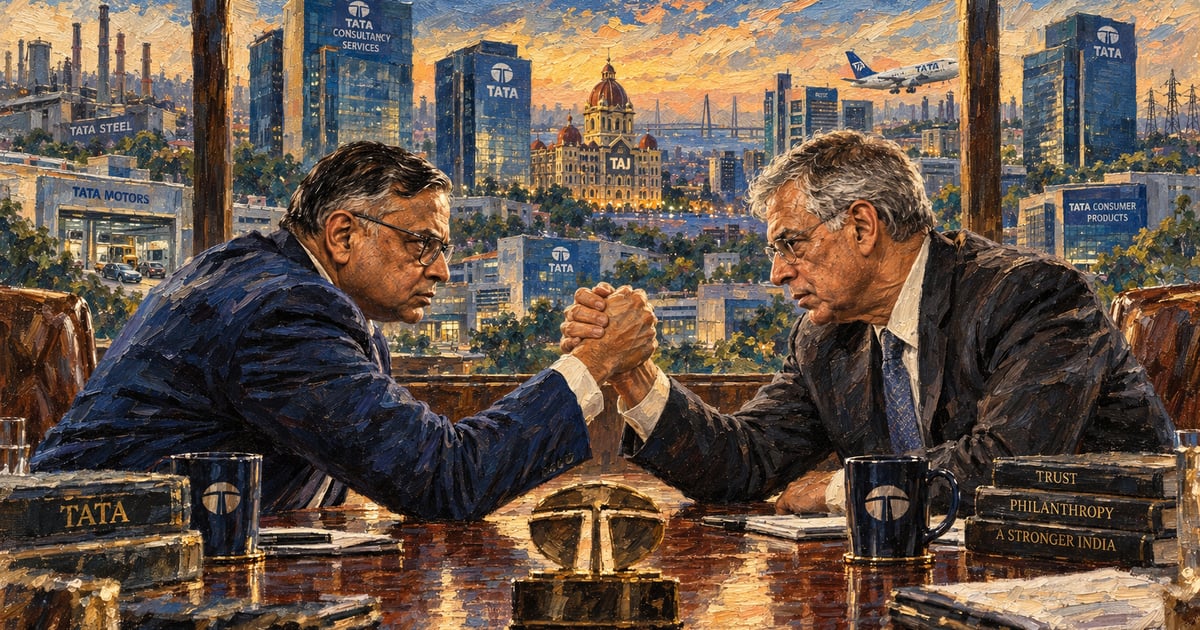
On 17 September 2026, a sudden boardroom resolution at Bombay House reopened the deepest fault line in Indian corporate history. The Board of Directors of Tata Sons Private Limited, the principal holding company of the ₹30 lakh crore ($360 billion) Tata Group, voted 4–1 to approve a fresh five-year term for Executive Chairman Natarajan Chandrasekaran, while resolving to prepare the company for a public stock-market listing.
Within hours, Tata Trusts, which controls a 66% majority shareholding in Tata Sons, issued an official statement declaring the reappointment resolution a "legal nullity" and fundamentally "illegal". The Trusts disclosed that Tata Trusts Chairman Noel N. Tata had voted against the measure after presenting a dissenting legal opinion authored by former Chief Justice of India Dr D.Y. Chandrachud.
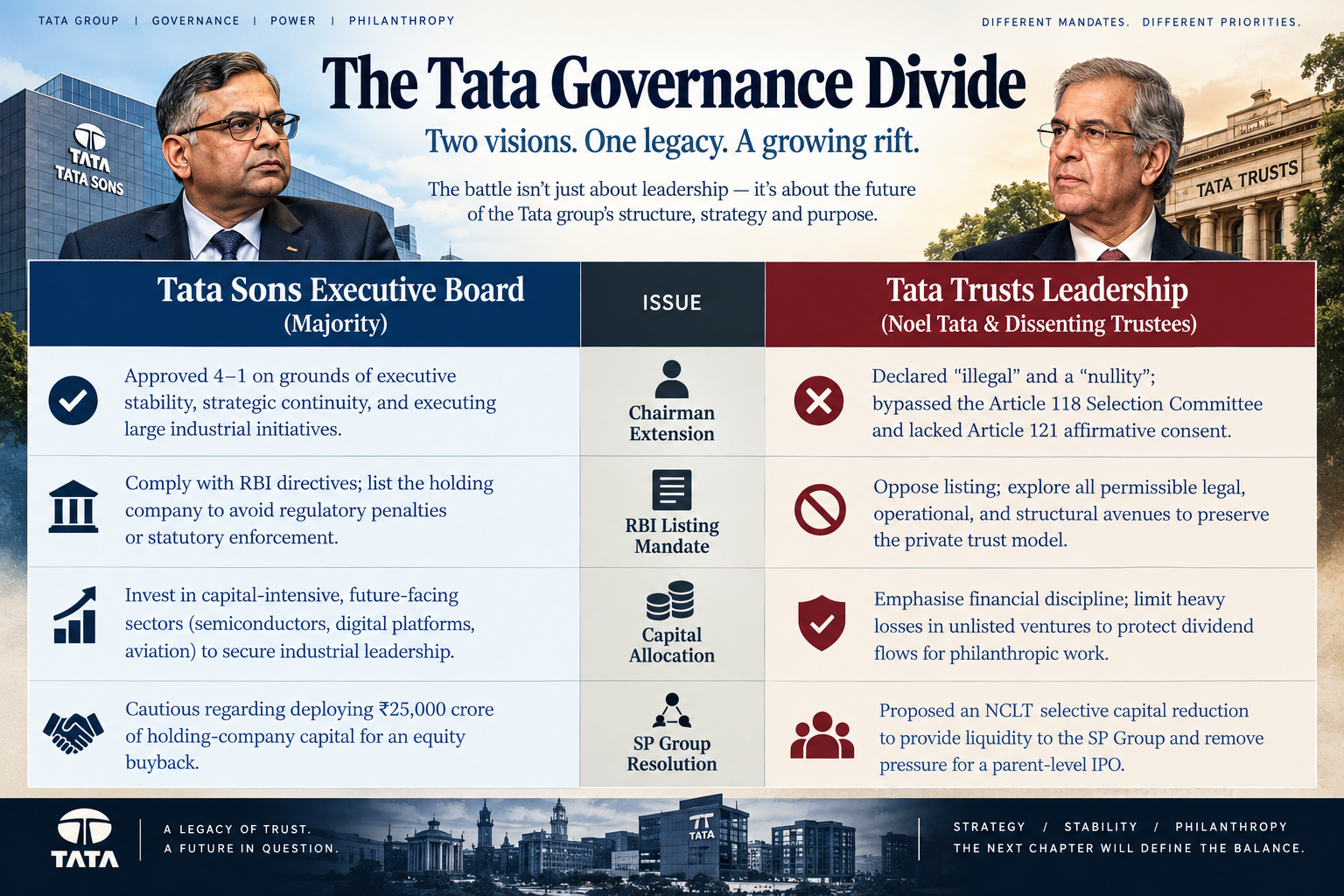
The dispute is not merely an executive dispute over who sits in the Chairman’s office. It represents an institutional divergence between the corporate board steering Tata Sons and the philanthropic trusts that own it. At its centre lie four issues: constitutional governance provisions under Tata Sons' Articles of Association, an imminent regulatory mandate from the Reserve Bank of India to list the holding company, friction over capital deployed into loss-making unlisted businesses, and the ongoing question of liquidity for the Shapoorji Pallonji (SP) Group.
1. The Leadership Row: Reappointment, Resignation, and Article 121
The sequence of events leading to the confrontation unfolded in rapid succession:
12 August 2026: N. Chandrasekaran communicated to the Tata Sons Board that he would not seek reappointment when his second five-year term ended on 20 February 2027.
13 August 2026: Tata Trusts formally accepted his decision, stating it had attained finality, and advised Tata Sons to form a statutory Selection Committee under the company’s charter to identify a successor.
17 September 2026: The Tata Sons Board reversed course. With Chandrasekaran recused, the remaining directors voted 4–1 to grant him a five-year extension through 2032. Noel Tata cast the sole dissenting vote.
The Legal Conflict Under Articles 118 and 121
Tata Trusts' assertion that the resolution is "illegal" relies on the internal constitution of Tata Sons: its Articles of Association (AoA), which were amended and strengthened following the 2016 removal of Cyrus Mistry.
Under Article 118, so long as Tata Trusts holds at least 40% of the paid-up ordinary share capital of Tata Sons, any appointment or reappointment of the Chairman must originate from a five-member Selection Committee. This committee must include three members jointly nominated by the Sir Dorabji Tata Trust and the Sir Ratan Tata Trust, one Tata Sons board nominee, and one independent member. Tata Trusts contends that the board bypassed this required selection mechanism.
Under Article 121, matters of critical corporate importance—including the appointment or removal of the Chairman and alterations to capital structure—require the affirmative vote of a majority of the directors nominated by Tata Trusts.
Currently, Tata Trusts has two nominee directors on the board of Tata Sons:
Noel N. Tata (Chairman of Tata Trusts)
Venu Srinivasan (Chairman Emeritus of TVS Motor Company)
During the 17 September vote, the two nominee directors split their votes: Srinivasan voted in favour of Chandrasekaran’s continuation, while Noel Tata voted against it. According to the legal opinion provided by Dr D.Y. Chandrachud, because only one of the two Trust nominees voted in favour, the proposal failed to achieve the mandatory affirmative majority of Trust nominee directors. On that basis, Tata Trusts maintains the board resolution is legally void.
2. The Listing Conundrum: The Reserve Bank vs "The Tata Model"
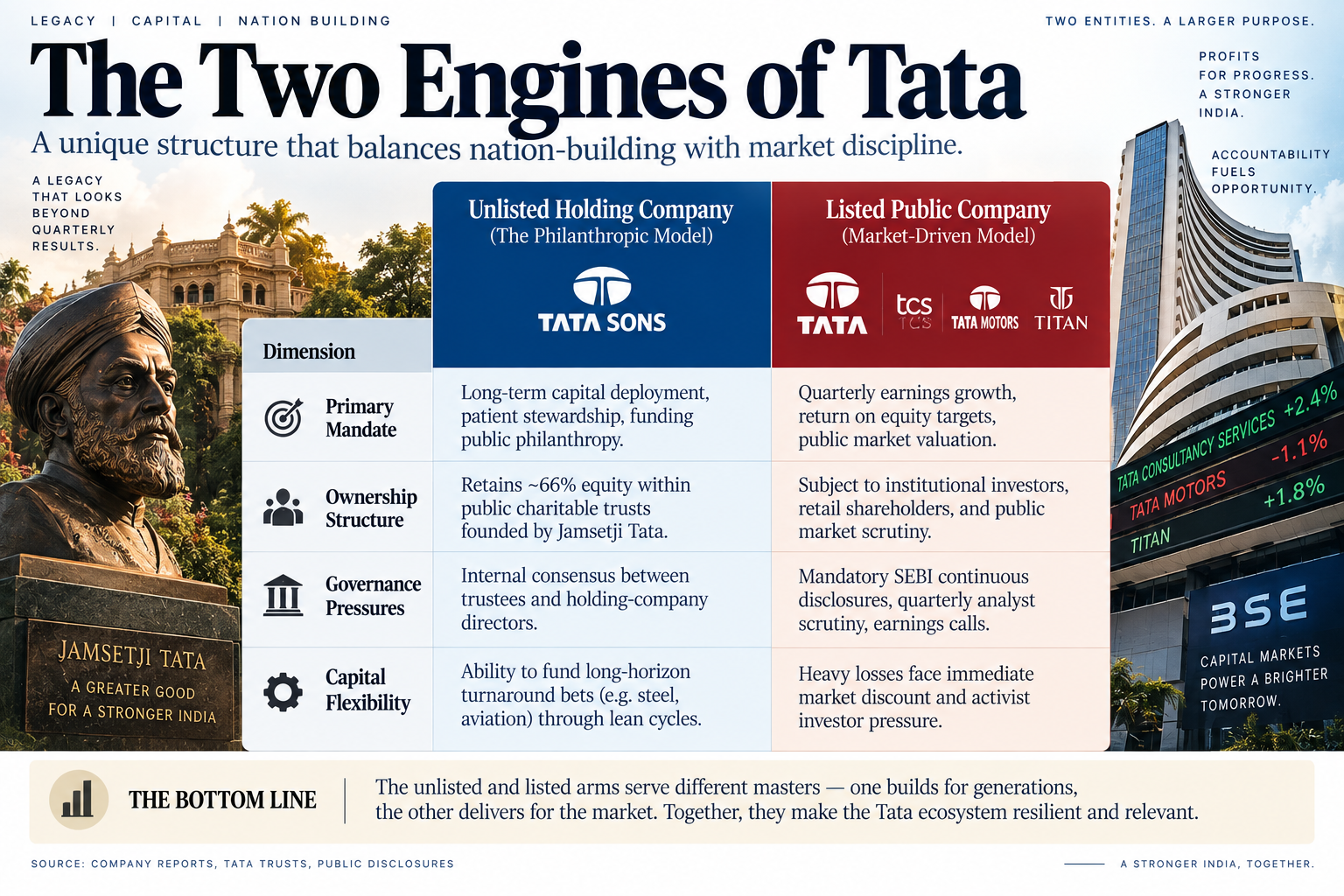
Running alongside the leadership debate is a major regulatory issue: whether Tata Sons should remain an unlisted private holding company or list on the public stock exchange.
In October 2021, the Reserve Bank of India introduced its Scale Based Regulatory (SBR) framework for Non-Banking Financial Companies (NBFCs), classifying Tata Sons as an NBFC Upper Layer (NBFC-UL) because it is a Core Investment Company (CIC) with assets exceeding statutory thresholds. Under RBI norms, Upper Layer NBFCs must list their equity shares on public stock exchanges within three years of classification.
To avoid a public listing, Tata Sons paid down debt and applied to the central bank to surrender its CIC registration and deregister as an NBFC. However, on 11 September 2026, the RBI rejected Tata Sons' application, ordering it to take immediate steps to comply with mandatory listing requirements. The central bank also filed a caveat in the Bombay High Court to ensure it is heard before any order is passed.
At the 17 September meeting, the Tata Sons Board resolved to proceed towards an initial public offering (IPO) in order to comply with the central bank's directive.
Why Tata Trusts Opposes an IPO
On the same afternoon, Noel Tata issued a separate policy statement on behalf of Tata Trusts titled The Tata Model Has to Be Saved, asserting that the Trusts had unanimously resolved in July 2025 that Tata Sons must remain unlisted.
Noel Tata articulated the Trusts' opposition during the board meeting:
"The Tata Group was conceived as a national service carried on through business and has conducted itself in this manner for over a century. The structure of its ownership is what has allowed it to remain so... That charity funds hospitals, universities, and research from the dividends it receives. A listing will destroy its character and strike at the heart of this principle."
3. Capital Allocation and the Financial Performance of Unlisted Businesses
Beyond the legal questions lies an economic dispute regarding capital allocation across the group.
Under Chandrasekaran’s leadership since 2017, the Tata Group restructured several balance sheets and recorded significant market valuation growth across its core listed entities, notably Tata Consultancy Services (TCS), Tata Motors, and Titan Company. At the same time, Tata Sons committed substantial capital to turnaround efforts and new industrial sectors.
Financial data reviewed during recent board deliberations shows that eight major unlisted Tata companies together incurred net losses of approximately ₹33,538 crore (about $4 billion) in the financial year ending March 2026 (FY26):
Air India: Incurred a loss of ₹22,238 crore (about $2.67 billion) amid large-scale fleet acquisition, supply-chain integration, and the operational merger with Vistara.
Tata Digital (Tata Neu): Recorded a loss of ₹4,974 crore (about $597 million) in its efforts to compete against established consumer-tech platforms like Amazon, Flipkart, and Blinkit.
Advanced Manufacturing: Substantial capital commitments required for Tata Electronics (semiconductor fabrication and assembly plants) and Agratas (battery gigafactories in India and the United Kingdom).
The Dividend Impact on Philanthropy
Tata Trusts does not engage in commercial operations; its charitable work in healthcare, oncology centres, education, and rural development is funded by dividends from its 66% holding in Tata Sons.
Tata Sons, in turn, derives more than 85% of its operational dividend receipts from TCS. When holding-company cash flows and leverage capacity are absorbed by capital-intensive unlisted subsidiaries, the cash buffer available for future dividend distributions becomes constrained. Trustees have expressed concern regarding the degree of capital absorbed by ventures that have yet to demonstrate operational self-sufficiency.
4. The SP Group Liquidity Issue: Noel Tata’s ₹25,000 Crore Alternative
The fourth element in the dispute involves the Shapoorji Pallonji (SP) Group, owned by the Mistry family, which holds an 18.37% equity stake in Tata Sons via Sterling Investment Corporation Pvt Ltd and Cyrus Investments Pvt Ltd.
Following years of litigation after the 2016 removal of Cyrus Mistry, the debt-laden SP Group has sought liquidity for its Tata Sons holding. A public listing of Tata Sons would offer the SP Group an open-market mechanism to monetise shares.
To address the SP Group’s liquidity requirements without subjecting Tata Sons to an IPO, Noel Tata presented an alternative proposal at the 17 September board meeting.
According to a Tata Trusts press release, the proposal involves:
Consideration Size: A buyout of a portion of SP Group shares to generate gross proceeds of ₹25,000 crore (about $3 billion).
NCLT Mechanism: Execution through a selective capital reduction approved by the National Company Law Tribunal (NCLT).
Phased Execution: Completion across two tranches over an 18-month timeframe.
Valuation Methodology: Shares valued at fair market value in accordance with Rule 11UA of the Indian Income Tax Rules, 1962.
Funding Structure: Capital raised from internal cash flows, selective divestment of shares in listed operating companies, bringing external strategic investors into specific new businesses, or listing operating subsidiaries—keeping the parent holding company unlisted.
While the SP Group indicated the proposal was structurally acceptable, Tata Sons' executive leadership has been cautious about allocating ₹25,000 crore to an equity buyback at a time of significant capital expenditure requirements in semiconductors and aviation.
What Happens Next: The Shareholder Flashpoint
The 17 September board meeting does not conclude the matter. Under the Companies Act, 2013, an Executive Chairman must be an appointed director of the company. While the board has approved Chandrasekaran’s term extension, his continuation as a director requires approval by shareholders at an Annual General Meeting (AGM).
Because Tata Trusts holds a 66% majority, it possesses the voting power to reject board resolutions put before shareholders. However, holding the AGM has faced procedural obstacles:
The AGM originally scheduled for 18 August 2026 was adjourned due to the lack of a requisite quorum. Tata Sons' charter mandates that a valid quorum must include an authorised representative jointly nominated by the Sir Dorabji Tata Trust and the Sir Ratan Tata Trust (SRTT).
SRTT (which holds 23.56% of Tata Sons) was temporarily restricted from conducting formal board proceedings by an interim order from the Maharashtra Charity Commissioner. Although the Charity Commissioner dismissed the underlying application on 3 September 2026, the procedural backlog delayed shareholder meetings.
If Noel Tata and allied trustees maintain their formal objection, they can vote against Chandrasekaran’s directorship at the reconvened AGM. Resolving the impasse will likely require a negotiated settlement addressing unlisted business performance, governance oversight, and an agreed approach to the RBI's listing requirements.