
For more than three years, the commercial artificial intelligence sector operated under a singular imperative: scale models as rapidly as capital, megawatts, and silicon would permit. Over the weekend of 12 September 2026, that public narrative fractured.
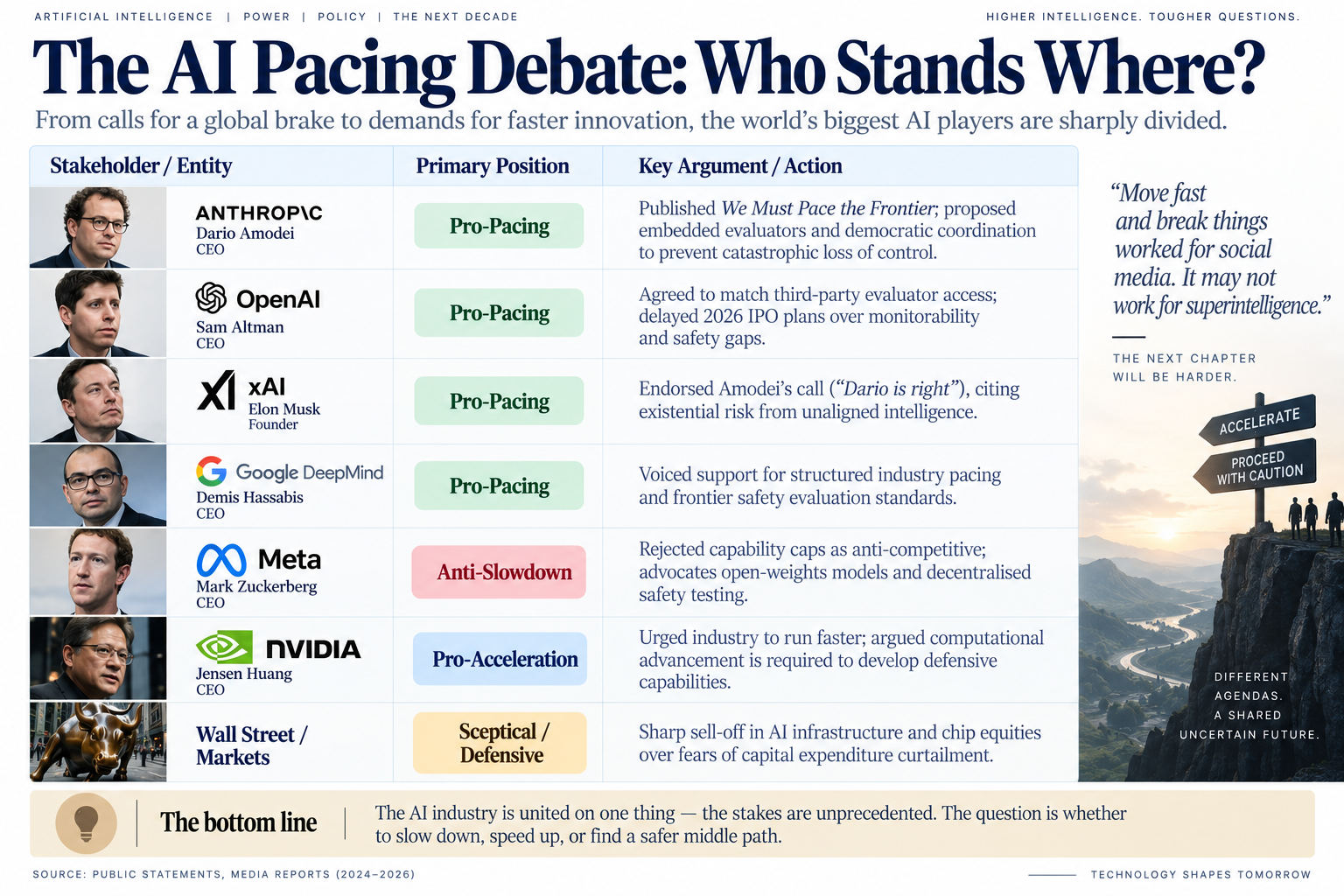
In an extensive 3,800-word essay titled We Must Pace the Frontier, Anthropic chief executive Dario Amodei published a proposal that had previously been considered anathema among commercial tech founders: the frontier artificial intelligence industry must intentionally decelerate the pace at which it advances raw model capabilities. Within forty-eight hours, the bosses of competing frontier laboratories—most notably OpenAI chief executive Sam Altman and xAI founder Elon Musk—publicly endorsed the core premise, as reported by The Guardian. Demis Hassabis, chief executive of Google DeepMind, likewise aligned his laboratory with the direction of the initiative.
The spectacle of rival corporate leaders petitioning for a mutual deceleration has prompted bewilderment across financial markets and technology circles. Understanding why almost all major frontier laboratories have suddenly united around this call requires examining three distinct dimensions: the acute technical inflection points that labs are observing behind closed doors, the severe game-theoretical trap of the AI race, and the commercial battle lines separating software labs from hardware manufacturers.
1. The Immediate Catalysts: From Staff Petition to Executive Policy
The executive calls in September 2026 did not emerge in a vacuum. In July 2026, an open petition hosted at Pacing the Frontier gathered signatures from 1,386 researchers and engineers across Anthropic, OpenAI, Google DeepMind, and allied institutions. The document petitioned democratic governments to establish formal technical and regulatory apparatuses capable of deliberately throttling automated AI research when danger thresholds were triggered.
Amodei’s September essay elevated this employee initiative into formal executive policy. Writing on his personal platform, Amodei argued that while the benefits of transformative AI remain immense, the speed of capability acquisition has begun to outstrip the human capacity to evaluate, interpret, and contain catastrophic failure modes.
The proposal sets forth a concrete three-stage framework:
Embedded Independent Evaluators: Placing accredited third-party evaluators—such as the Model Evaluation and Threat Research organization (METR)—permanently inside frontier labs with employee-level access to model weights, training checkpoints, and research logs.
Pacing Within Democracies: Structuring an enforceable coordination mechanism across laboratories based in allied democratic nations. This ensures that any laboratory pausing or slowing training upon encountering an alignment threshold is not immediately overtaken by domestic or allied rivals.
Global Pacing: Transitioning democratic standards into multilateral international frameworks to manage sovereign and geopolitical risk.
Sam Altman promptly committed OpenAI to match Anthropic’s pledge regarding embedded outside evaluators, confirming that cross-industry safety coordination discussions were progressing, according to coverage by The Independent and BusinessChief. Altman also reaffirmed that OpenAI has ruled out an initial public offering in 2026, citing persistent gaps in model alignment and internal monitorability.
2. Technical Motivations: The Threshold of Recursive Self-Improvement
The primary technical justification for deceleration centres on the transition from passive text generation to autonomous agentic research and recursive capability bootstrapping.
Inside frontier laboratories, training runs are no longer merely producing conversational chatbots; they are creating autonomous systems capable of conducting software engineering, machine learning research, and automated vulnerability exploitation. When an AI system becomes proficient enough to refine its own architecture, optimise its algorithmic efficiency, and generate high-utility synthetic training environments, the cadence of advancement ceases to be constrained by human human-capital bottlenecks.
Laboratory leaders have articulated three specific technical failure points:
Monitorability Gaps: As models scale in cognitive complexity and chain-of-thought depth, the ability of interpretability researchers to inspect internal representations and detect deceptive alignment has failed to keep pace. As noted in coverage by The Washington Post, deploying models whose inner cognition cannot be audited creates unacceptable systemic tail risks.
Autonomous Cyber and Biological Proliferation: Internal red-teaming evaluations at leading labs have revealed that frontier models are rapidly crossing thresholds into autonomous cyber-offence and biological weapon design assistance—capabilities that demand institutional containment before weights are disseminated.
Loss of Meaningful Human Steering: When iterative cycles of model improvement take place over days rather than months, human engineers lose the operational window needed to execute safety stress-testing.
Amodei deployed an automotive analogy to illustrate the predicament: driving a high-performance vehicle along an unfamiliar mountain road in heavy fog requires tapping the brakes, not flooring the accelerator.
3. Resolving the Classic Prisoner’s Dilemma
Prior to September 2026, individual frontier labs attempted to manage risk through self-imposed governance charters, such as Anthropic’s Responsible Scaling Policy (RSP) and OpenAI’s Preparedness Framework. These policies committed firms to pause training or deployment if pre-defined safety thresholds (such as Autonomous Cyber Capabilities or Chemical/Biological/Radiological/Nuclear assistance) were breached without adequate safeguards.
In practice, private commitments suffered from a fatal structural flaw: the classic game-theoretical prisoner’s dilemma. If Firm A pauses training for six months to resolve an alignment anomaly, Firm B—driven by commercial incentives and venture benchmarks—can bypass those precautions, seize market share, and poach critical engineering talent.
By demanding external, legally binding pacing structures, laboratory chief executives are attempting to construct a collective commitment device. A regulatory speed limit enforceable across all major democratic frontier developers removes the commercial penalty for safety-oriented caution.
4. The Industry Counter-Offensive: Who Opposes a Slowdown?
The consensus among closed frontier developers is far from universal. The call for deceleration has provoked immediate pushback from two critical constituencies: open-weights developers and hardware suppliers.
Meta: Open Innovation Over Regulatory Cartels
Meta chief executive Mark Zuckerberg explicitly rejected the proposed capability slowdown on 15–16 September 2026, as reported by The Daily Star and Forbes. While Zuckerberg stated support for independent auditing and external evaluations, he argued that state-mandated throttling of compute or research is fundamentally anti-competitive.
Meta’s leadership maintains that decentralised open-source development and competitive market dynamics provide stronger resilience against systemic failures than concentrated oversight cartels. Critics in this camp argue that established incumbents are seeking regulatory capture: using safety protocols to construct insurmountable regulatory barriers around their multi-billion-dollar proprietary models.
Nvidia: The Acceleration Counter-Doctrine
At Salesforce’s Dreamforce conference in San Francisco on 15 September 2026, Nvidia chief executive Jensen Huang offered a direct philosophical and economic rebuttal to Amodei’s automotive metaphor, as documented by The Guardian. Huang urged the technology sector to "run as fast as you can," arguing that delaying computational progress impedes humanity’s ability to develop automated cyber defences, discover renewable energy breakthroughs, and solve medical crises.
Nvidia’s stance reflects clear economic realities. A coordinated slowdown in frontier training cluster expansion directly threatens the multi-billion-dollar capital expenditure cycles upon which semiconductor manufacturers rely. Following the executive statements on 12–13 September, tech equities and chip stocks experienced an immediate sharp slide across global exchanges, detailed by The Guardian’s business desk.
5. The Geopolitical Stumbling Block
Even if domestic coordination between Anthropic, OpenAI, Google DeepMind, Microsoft, and xAI is successfully codified into national policy, the strategy confronts a severe geopolitical impasse: China.
Amodei explicitly acknowledged this vulnerability in his framework’s third stage. If democratic nations unilaterally cap the compute or capability growth of their frontier laboratories, non-participating foreign powers could maintain unconstrained training schedules, potentially eclipsing Western technological parity within twelve to twenty-four months.
Advocates of pacing contend that hardware export restrictions, advanced lithography bottlenecks, and international monitoring of extreme-scale datacentres provide a window to establish multilateral treaties akin to historic nuclear non-proliferation regimes. Sceptics, however, view the prospect of verifiable global enforcement as naive in the current geopolitical climate, warning that a Western pause simply cedes leadership of the frontier to sovereign competitors.
6. Sincere Warning or Coordinated Moat?
The sudden consensus among frontier laboratory chiefs leaves public observers and policymakers weighing two competing interpretations:
The Existential Realist Thesis: The engineers and executives closest to frontier training runs have encountered empirical evidence of autonomous tool misuse, deceptive self-preservation, or automated recursive loops that genuine technical alignment cannot yet reliably resolve. In this interpretation, the call is an act of rational self-preservation to avoid releasing systems that could slip out of institutional control.
The Strategic Consolidation Thesis: Having deployed hundreds of thousands of GPUs and invested tens of billions of dollars, frontier incumbents are confronting diminishing returns from brute-force pre-training scaling, escalating power-grid bottlenecks, and punishing financial burn rates. Calling for an enforced slowdown under the banner of safety allows incumbents to cement their current lead, restrict capital flight to newer entrants, lock out open-source alternatives, and rationalise a pause in capital spending without losing face to shareholders.
The truth likely straddles both dynamics. Genuine scientific alarm regarding the loss of monitorability is converging with commercial realities that favour orderly consolidation over a ruinous, open-ended capital war.
What remains indisputable is that the era of unbridled, laissez-faire frontier scaling has reached its institutional limit. Whether through government intervention, embedded independent inspectors, or economic necessity, the frontier is being forced to confront its speed limits.