
When developers embed frontier large language models (LLMs) into backend services or autonomous agent harnesses, the objective is rarely to write an essay. In production pipelines, most model calls perform mundane, discrete evaluations: classifying incoming customer tickets, routing user queries to specialised sub-agents, validating tool inputs, or scoring conversational risk.
Using an autoregressive frontier model for these micro-judgments has long represented an expensive mismatch. Developers pay steep per-token rates and endure multi-second latencies while a multi-billion-parameter network predicts tokens one by one, only to output a single structured JSON object containing a boolean flag or an enum.
On 15 September 2026, San Francisco startup TypeSafe AI emerged from stealth with a $40 million seed round led by DCVC and announced early access to Jev (initial build jev-1.13.0). Founded by former OpenAI researcher Diogo Almeida—a co-author of the foundational InstructGPT work—TypeSafe AI designed Jev to do one thing: return typed, probabilistic decisions directly into code without generating a single word of prose.
Within hours of its release, the model ignited widespread discussion across developer communities, drawing more than 1,500 points on Hacker News and immediate day-one integrations from orchestrators like LangChain and PydanticAI.
Understanding why Jev has captured the attention of software engineers requires examining how it works, how its architecture fundamentally departs from standard LLMs, and the trade-offs inherent in its design.
What Is Jev? The "System One" Concept
TypeSafe AI markets Jev as the industry’s first commercial System One model. The terminology draws directly from psychologist Daniel Kahneman’s dual-process cognitive framework in Thinking, Fast and Slow:
System 1: Fast, instinctive, automatic, and frugal.
System 2: Slow, analytical, deliberative, and computationally demanding.
Mainstream generative models—such as GPT-5, Claude, or Gemini—operate largely in the System 2 regime when performing complex reasoning, producing extended chains of thought and detailed textual explanations. Jev is intentionally restricted to System 1: it provides the immediate, unelaborated judgment required to route an event or trigger a software branch thousands of times per hour.
The name "Jev" is an explicit reference to 19th-century British economist William Stanley Jevons, author of the Jevons Paradox. In resource economics, the paradox posits that technological improvements that increase the efficiency of using a resource tend to increase—rather than decrease—the total consumption of that resource. TypeSafe AI’s thesis is identical: if the latency and financial cost of machine intelligence drop by two orders of magnitude, developers will not simply make existing calls more cheaply; they will embed intelligence across hundreds of micro-decisions previously left to brittle heuristic code.
The Three Typed Primitives
Jev does not feature a chat endpoint or free-form text output. Its API accepts two inputs:
State: Unstructured text or raw JSON representing the context to be evaluated (up to 32,000 tokens of state within a 64,000-token total context window).
Questions: One or more strongly typed questions defined programmatically in code.
The model responds strictly with one of three structured output primitives, as documented by Sanity's technical glossary and DataCamp's architecture explainer:
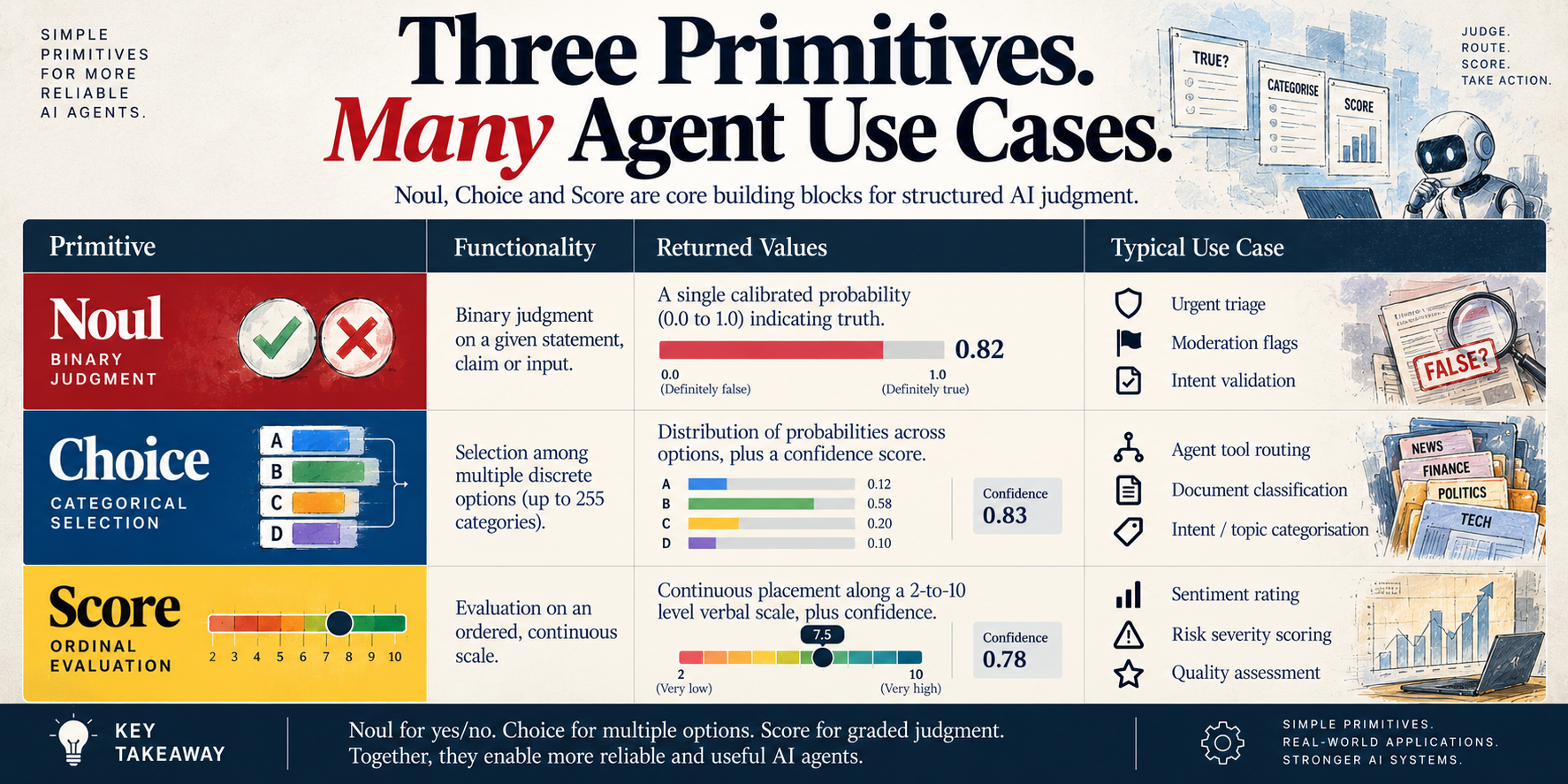
1. Non-Autoregressive Parallel Forward Pass
Traditional LLMs generate text token by token, where each subsequent token requires a full pass through the model conditioned on all previously generated tokens. Even when constrained by grammar engines (like Outlines or JSON schema mode), the model must still step through the decoding loop.
According to independent architectural analyses published by Flowtivity and MindStudio, Jev completely circumvents sequential token decoding. Instead of generating characters, Jev scores all defined questions across the input state simultaneously in a single, parallel forward pass.
Because questions are evaluated concurrently against a shared contextual representation, querying multiple facets of an input—for instance, evaluating whether a customer message is urgent, abusive, and billing-related in a single request—incurs minimal additional latency and requires only the minimal input tokens needed to specify the extra questions.
2. Output Tokens Are Free
Because Jev avoids sequential decoding, TypeSafe AI bills exclusively for input tokens: $0.042 per million input tokens, while output tokens are unmetered and free.
By comparison, frontier models typically price output tokens between $5.00 and $30.00 per million, often charging 3× to 5× more for generation than input ingestion. For an enterprise processing 40,000 document routing decisions monthly on 800-token payloads (roughly 32 million input tokens), a monthly Jev bill totals approximately $1.34. The identical throughput routed through standard frontier models running JSON-mode extraction regularly costs between $90 and $900 per month.
3. Sub-Second Latency Profiles
Standard generative LLMs processing complex prompts typically exhibit end-to-end latencies between 2,000 ms and 15,000 ms (or over 300 seconds for models employing extended chain-of-thought verification). Jev reports round-trip response times between 70 ms and 500 ms, enabling it to sit directly in synchronous request-response loops, HTTP middlewares, and edge proxies.
4. Training via RLCD Rather Than RLHF
Standard chat assistants rely on Reinforcement Learning from Human Feedback (RLHF), which aligns models toward conversational agreeableness, tone, and formatting compliance. Jev was trained using Reinforcement Learning for Calibrated Decisions (RLCD). RLCD optimises the model’s internal loss functions around probabilistic calibration: ensuring that when Jev reports an 85% probability on a Noul judgment, the empirical ground truth matches that 85% rate across large sample populations.
Why Is Everyone Talking About It?
The enthusiasm surrounding Jev stems from several overlapping technical and economic dynamics:
1. Solving the Developer "Parsing Tax"
Building resilient production agents has historically required wrapping model calls in defensive retry loops to catch JSON schema violations, truncated outputs, or unexpected markdown formatting. Because Jev's output is structurally bound to typed primitives, its schema error rate is theoretically 0%. The API cannot output tokens outside the predefined enum or probability boundary.
2. Enabling Low-Cost Agent Loops
Modern agent frameworks execute repetitive loops: observe state, select an action, invoke a tool, assess the output, and decide whether to continue. In a blog post exploring agent harnesses, LangChain demonstrated how Jev can be implemented as an AutoMode middleware or dynamic model router. Rather than prompting a massive general-purpose model to verify if a bash command is safe or to choose which model to invoke, Jev handles the gatekeeping check in under 100 ms for fractions of a cent.
3. Rapid Ecosystem Integration
Within a week of launch, multiple enterprise and open-source infrastructure providers rolled out native support:
Spring AI launched a dedicated community integration (
Spring AI TypeSafe) for Java enterprise backends.Fly.io introduced a native connector for Fly Sprites to power agentic decision-making.
Netlify AI Gateway integrated the TypeScript SDK directly into Netlify Functions.
OpenRouter listed
typesafe/jev-1.13on its multi-model routing exchange.
Limitations, Skepticism, and the Production Reality
Despite the early momentum, independent audits and developer scrutiny—particularly following Jev's Hacker News debut—highlight critical caveats that teams must consider.
"Zero Hallucinations" Is About Format, Not Accuracy
TypeSafe AI’s initial marketing claimed the model "cannot hallucinate." In discussions on Hacker News, CEO Diogo Almeida acknowledged that this guarantee refers strictly to schema validity. Jev cannot output an invalid JSON tag or an unlisted enum option, but it can still make an incorrect judgment. A model can return a well-typed, schema-valid choice with 98% confidence that is completely wrong about the underlying facts.
The Benchmarks Are Vendor-Graded
TypeSafe AI reported that on its four internal workflow evaluations, Jev matched the accuracy of frontier models while operating up to 193.6× faster and 444.6× cheaper:
On the vendor benchmark, Jev achieved 67.8% accuracy, matching GPT-5.6 Terra (67.9%) and slightly trailing GPT-5.6 Sol (74.1%) and Claude Opus 5 (73.1%).
Crucially, the "ground truth" labels in this benchmark were established by taking the consensus output of GPT-6 Astra and Claude Fable 5.1, rather than independently verified human datasets. Independent third-party benchmarks have yet to be published.
Explicit Model Blind Spots
In its documentation and nuance notes, TypeSafe AI explicitly documents tasks where Jev should not be used:
Counting: Jev struggles with numerical frequency calculations (e.g., counting how many times an error appears in a log file), with error rates compounding as counts increase.
Temporal and Date Reasoning: Jev parses dates as literal text strings rather than chronological values. It cannot reliably determine whether one timestamp occurred before or after another without custom preprocessing.
Multimodal Data: Jev remains strictly text- and JSON-based; it cannot evaluate images, audio, or video.
Closed Ecosystem: Jev is accessible only via a hosted, waitlisted API endpoint (
POST https://api.typesafe.ai/v1/systemone). There are no open weights, preventing on-premises deployment or private cloud hosting.
The Emerging Pattern: The Dual-Process AI Stack
Jev does not make general-purpose generative models obsolete. Instead, production architectures are coalescing around a complementary hybrid design:
Jev at the Edge and Core: Evaluates incoming payloads, triages support requests, filters toxic inputs, checks security policies before tool execution, and routes traffic.
Generative LLMs at the Leaf Nodes: When a task genuinely demands language synthesis, code authoring, or creative problem solving, the system routes the request to a frontier generative model.
Jev as the Guardrail: Once the generative model completes its drafting phase, a secondary Jev call evaluates the output against quality, policy, and tone metrics before delivery.
By relegating the high-frequency decision layer to a dedicated, non-autoregressive model, engineering teams can eliminate significant operational costs and latency bottlenecks while preserving generative intelligence for tasks that actually require it.