
When Singapore’s Government Technology Agency rolled out FirstDate—an internal matchmaking platform piloted for unmarried public officers aged 21 to 35—it was born not in a boardroom of romantic idealists, but at an internal civil service hackathon.
The mechanics reflect the state's hallmark administrative precision. Participants log in using their national digital identity (Singpass), verifying their age, marital status, and government employer. They answer 30 structured questions assessing lifestyle, personal values, dealbreakers, and whether they want children. Crucially, there are no profile photos to browse and no endless swipe decks. Instead, the system produces a single recommended match approximately once a month, granting each party three days to review an anonymised compatibility dossier and decide whether to accept.
Powering this digital parlour is the Gale-Shapley Stable Marriage algorithm, a mathematical formulation published in 1962 by David Gale and Lloyd Shapley that earned Shapley the 2012 Nobel Memorial Prize in Economic Sciences. Commonly employed to assign medical graduates to hospital residencies or pupils to high schools, Gale-Shapley seeks systemic stability: a state where no two individuals in a pool would mutually prefer each other over their allocated partners.
The platform arrives amidst acute demographic urgency. According to official data reported by Al Jazeera, Singapore’s total fertility rate slipped to a historic low of 0.87 births per woman in 2025, down from 0.97 in 2024 and far below the 2.1 replacement threshold. Fewer than 30,000 resident infants were born in 2025.
At the National Day Rally 2026, Prime Minister Lawrence Wong announced that the state will provide nearly S$70,000 (roughly ₹45 lakh, or $55,000) in direct financial assistance for each Singaporean child from birth to age 17, consolidating and expanding family subsidies while extending cash benefits to unwed parents for the first time.
Yet, as the state supplements financial transfers with algorithmic matchmaking, public reception across Singapore has hovered between amusement and weariness. The initiative has revived long-standing debates regarding the limits of state intervention in a society often described as a "golden cage"—an immaculate, prosperous enclave where life is comfortable, structured, and overseen by a paternalistic government, but where personal autonomy is frequently channeled into national economic objectives.
The Return of the Bureaucratic Cupid
State matchmaking is not an innovation of the digital era in Singapore; it is a foundational policy instinct.
In August 1983, founding Prime Minister Lee Kuan Yew triggered what local historians term the "Great Marriage Debate". Alarmed that university-educated women were staying single or having fewer children than their less-educated peers, Lee warned that Singapore’s talent pool would deteriorate if higher-earning citizens failed to reproduce.
The following year, the government established the Social Development Unit (SDU) to facilitate courtships among tertiary graduates, complete with state-subsidised love-boat cruises and tea dances. Predictably lampooned by citizens as "Single, Desperate and Ugly", the SDU drew intense criticism for overt elitism, compelling the administration to launch the Social Development Section (SDS) in 1985 for non-graduates.
Those units were eventually consolidated in 2009 into the Social Development Network (SDN), which pivoted away from direct dating management towards accrediting private matchmakers.
GovTech’s FirstDate signals a return to direct intervention, updated for an era defined by digital exhaustion. Commercial dating applications rely on business models engineered to maximise user engagement and retention; they benefit when users remain active, paying, and unattached. FirstDate operates under an opposing institutional mandate: the state wants its employees paired off, married, settled into public housing, and raising the next generation of taxpayers.
Gale-Shapley and the Mechanics of "Stable" Romance
The application of Gale-Shapley illuminates how Singapore’s technocracy conceptualises human problems.
In market design, stable matching resolves coordination failures. In a medical residency match, it ensures hospitals and doctors reach an equilibrium without chaotic bidding wars. Applied to dating, the algorithm replaces visual attraction with a matrix of preferences and dealbreakers.
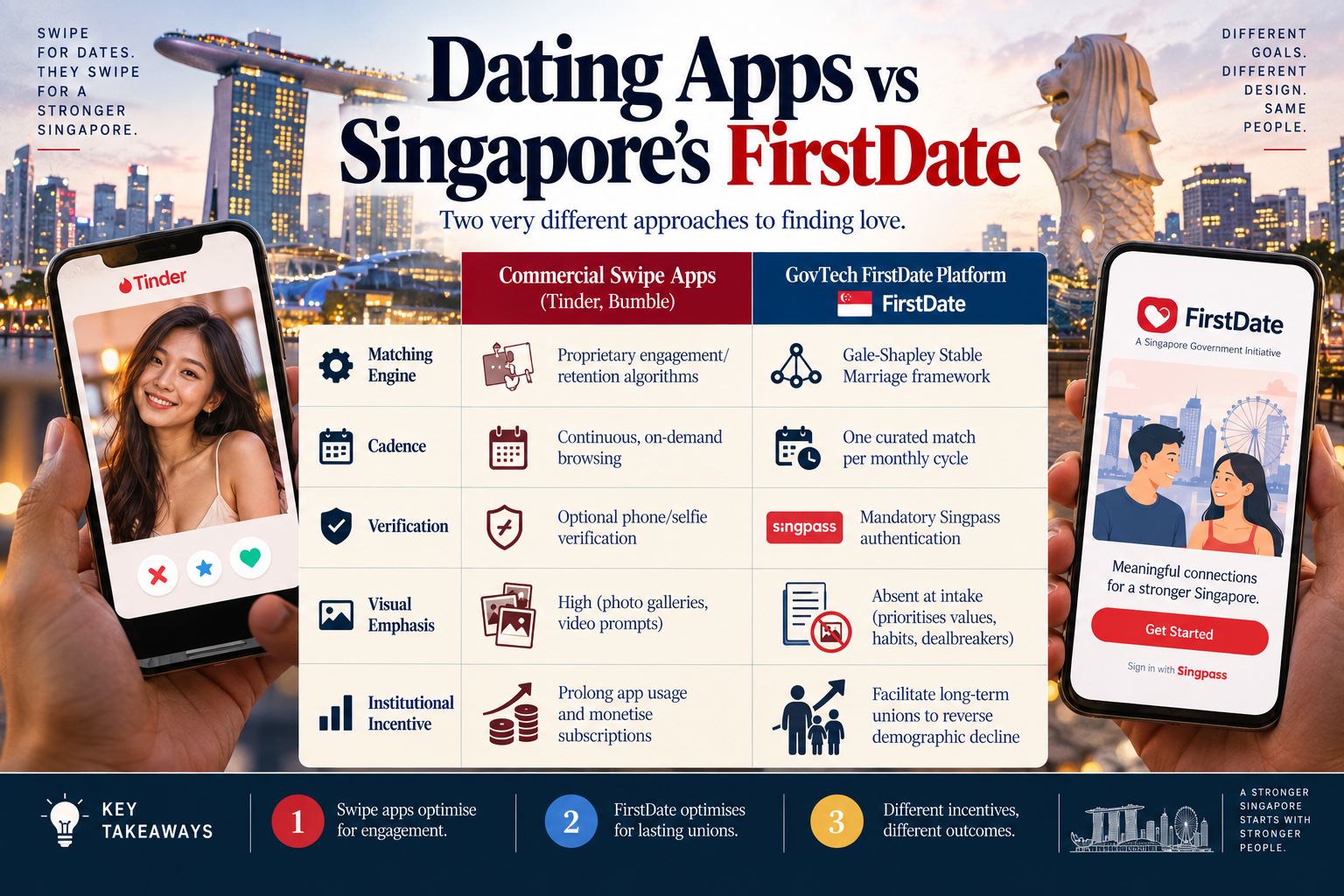
However, human courtship diverges sharply from institutional allocations. As psychologists and social researchers point out, questionnaires cannot measure physical chemistry, conversational cadence, emotional maturity, or mutual attraction. Gale-Shapley calculates optimal stability on paper based on stated preferences, but it cannot ensure emotional resonance across a dinner table.
The Architecture of the "Golden Cage"
To understand why young Singaporeans view FirstDate with hesitation, one must examine the socio-economic framework within which they live.
Singapore's post-independence social contract has rested on providing safety, clean governance, world-class infrastructure, and accessible public housing through the Housing & Development Board (HDB), in which roughly 80% of resident households reside. In return, citizens accept a tightly managed political environment, rigorous social regulations, and an intense, market-driven work culture.
This system creates structural contradictions for romance:
The BTO Matrimonial Trap: Because subsidized HDB Build-To-Order flats take three to five years to construct, couples routinely apply for housing years before marriage. "Will you BTO with me?" has famously replaced the traditional proposal. Relationships become financial joint ventures long before emotional certainty matures, and breakups carry substantial financial penalties if flat deposits are forfeited.
The Singlehood Penalty: Unmarried citizens are barred from buying new public housing flats independently until they reach the age of 35. This restriction forces many young professionals to live with their parents well into their thirties or navigate an expensive private rental market, severely curtailing the informal, domestic autonomy that fosters natural courtship.
Professional Depletion: The intensity of Singapore's corporate and civil service environments leaves little energy for social life. As public officers noted during the FirstDate rollout, working ten- to twelve-hour days creates a deficit not of matching opportunities, but of emotional and physical bandwidth.
Data Entrustment to the Employer: Logging into a dating platform via Singpass means handing relationship intentions, lifestyle quirks, and reproductive timelines to the state. For civil servants whose career advancement depends on bureaucratic assessments, providing intimate data to a government-operated database introduces workplace surveillance concerns.
Cash, Algorithms, and the Limits of Social Engineering
Prime Minister Lawrence Wong’s enhanced family package at the 2026 National Day Rally—providing almost S$70,000 (₹45 lakh) across a child's first 17 years—demonstrates that Singapore does not shy away from fiscal intervention. Expanding benefits to unwed parents reflects a pragmatic widening of the traditional family framework.
Yet, across developed East Asia, financial incentives have consistently failed to arrest falling birthrates. South Korea, Japan, and Taiwan have spent tens of billions of dollars on baby bonuses, subsidised childcare, and state-sponsored mixers, only to see fertility figures stagnate or decline. Tokyo launched its own municipal dating app, Tokyo Enmusubi, in 2024, while Seoul has sponsored matchmaking events along the Han River; neither has meaningfully shifted regional family formation trends.
The limitation lies in the assumption that family creation is an optimisation problem solvable by subsidies and matching algorithms. Singapore's fertility slump is not driven by an absence of available singles or ignorance of financial grants; it is driven by a rational calculation among young adults who view parenthood as incompatible with the relentless performance demands of modern urban life.
Pragmatic Trial or Technocratic Overreach?
GovTech has emphasised that FirstDate remains an exploratory pilot with no confirmed plans for a national rollout. As an internal civil service experiment, it is relatively harmless: participation is voluntary, identity fraud is eliminated via Singpass, and escaping the superficial churn of commercial swipe apps offers genuine relief to some participants.
The deeper unease stems from what the experiment reveals about governance. When a state responds to existential demographic decline by writing algorithms to pair off its own employees, it treats human intimacy as another national supply-chain deficit to be resolved through institutional engineering.
Singapore’s golden cage remains exceptionally comfortable, prosperous, and secure. But within its gilded bars, love, partnership, and family cannot simply be administered through policy decrees and Nobel Prize formulas. Until the structural pressures of housing timelines, living costs, and workplace exhaustion are dismantled, even the most elegant mathematical matching engine will struggle to engineer human affection.